
Ask what men buy for their own pleasure and most people picture something designed for the penis. The answer, according to the people who actually sell sex toys, is more surprising: a large share of what men buy is designed for the prostate.
The short version
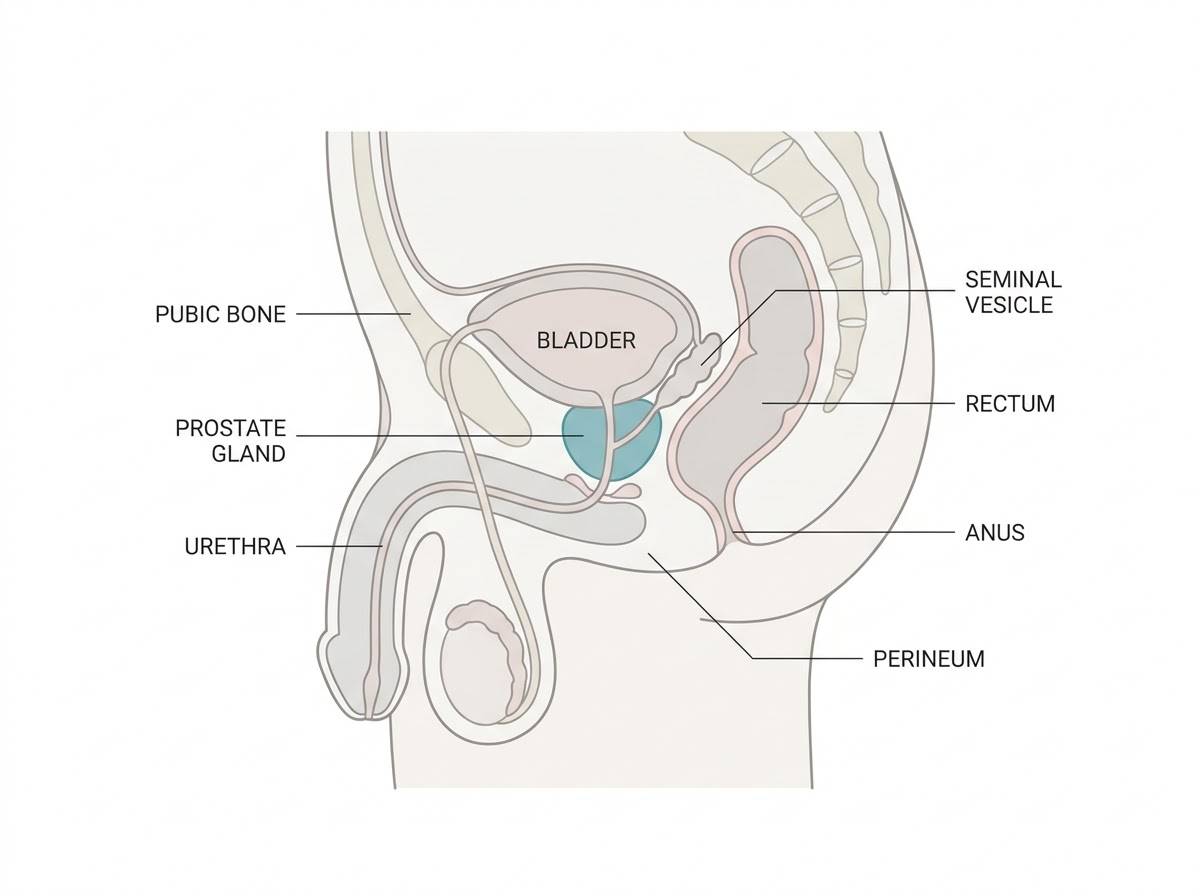
- The prostate is a walnut-sized gland below the bladder, reachable through the front wall of the rectum or indirectly through the perineum.
- Stimulating it can produce intense orgasms that many men describe as different from penile orgasms.
- Enjoying it says nothing about sexual orientation. Orientation is about who you are attracted to, not which nerves respond to touch.
- It is a massage, not intercourse: the finger or toy stays inside and works on the gland rather than sliding in and out.
- Like breast self-awareness for women, knowing how your prostate normally feels helps you notice changes, such as swelling or a hard area, and show them to a doctor early.
- It is safe for healthy adults when done slowly, with lots of lubricant and toys designed for anal use.
- Pain, bleeding or fever are signals to stop and see a doctor.
01The best-selling secret nobody talks about
In an interview, the founder of a sex toy company described a pattern in her sales that surprises most people. Toys designed for women were, unsurprisingly, the biggest sellers. Toys for men were a smaller category — but within it, conventional toys for penile stimulation were the minority. A larger share of the toys men bought were designed for prostate stimulation.
That fits what research shows about men and sex toys more broadly. A nationally representative US study found that 44.8 percent of men had used a vibrator during sexual activity, with no significant difference between heterosexual and gay or bisexual men.1 A national survey of heterosexual adults in Germany found that 16 percent of heterosexual men had used anal toys — statistically the same share as heterosexual women.2
of US men have used a vibrator during sexual activity1
of heterosexual German men have used anal toys, the same share as women2
prostate per man, and almost no public conversation about the pleasure it can give
In other words, a lot of men are quietly curious, and a lot of them are buying. What is missing is the conversation. This article is an attempt to have it plainly: what the prostate is, why it can feel so good, and why the taboo around it deserves to go.
02What the prostate is
The prostate is a gland about the size of a walnut. It sits just below the bladder and in front of the rectum, and it wraps around the urethra, the tube that carries urine and semen out of the body.3 Its main job is reproductive: it produces fluid that forms part of semen and helps carry sperm during ejaculation.3
Most men only hear about the prostate in a medical context — enlarged prostates, prostate exams, prostate cancer screening. That framing is important, but it leaves out something every urologist knows: the prostate sits at the centre of the male sexual response, surrounded by nerves and muscles involved in arousal, erection and ejaculation.
03The anatomy of pleasure
Because of where it sits, the prostate can be stimulated in two ways.
Internally, through the rectal wall
The prostate lies against the front wall of the rectum. A finger or toy inserted a few centimetres and curved towards the front of the body — in the direction of the navel — meets it as a smooth, rounded bump. This is the same route doctors use for a digital rectal examination. It is also why the prostate is sometimes called the male G-spot or P-spot: like the G-spot area in women, it is an internal, pressure-sensitive zone reached through the front wall of a canal.
Externally, through the perineum
The perineum is the area of skin between the scrotum and the anus. Firm pressure there reaches the prostate indirectly. It is subtler than internal stimulation, but it requires no penetration at all, which makes it the natural first step for anyone curious and cautious.
The two sphincters
The anal canal is closed by two rings of muscle. The internal sphincter is involuntary: you cannot relax it on command. The external sphincter is voluntary, under conscious control.4 This explains most first-time discomfort. Anxiety tightens both, and pushing against tension hurts. Patience, breathing and arousal relax them, and that is when stimulation becomes comfortable and pleasurable.
Almost every bad first experience with prostate play comes down to going too fast. The body has to relax before it can enjoy anything.
04What a prostate orgasm is
A prostate orgasm is an orgasm produced mainly by stimulating the prostate rather than the penis. A review published in the journal Clinical Anatomy by sexual physiologist Roy Levin brought together what is known about prostate-induced orgasms, noting that they can be intensely pleasurable and that science has largely overlooked them.5
Men who experience prostate orgasms often describe them differently from penile ones: more diffuse, felt through the whole pelvis, building more slowly and lasting longer. Some describe orgasms with little or no ejaculation, others a slow release of fluid rather than a typical ejaculation. Experiences vary a great deal, and the research is still young, so the honest answer is that there is no single correct way for it to feel.
What most people agree on is that it takes time. Prostate stimulation is often learned rather than discovered all at once, especially for men whose sexual habits have centred entirely on the penis. Many begin by combining both kinds of stimulation, and let the prostate sensations take a larger role over several sessions.
A massage, not intercourse
The most common misconception about prostate play is that a finger or toy should slide in and out, the way it would during intercourse. It should not. The prostate is a gland to be massaged, not a canal to be thrust into. Once the finger or toy is inside and resting on the gland, it stays there: the entrance stays still and relaxed, and all the movement happens against the prostate itself.
Thrusting mostly stimulates the sensitive entrance, where the sphincters are, and barely touches the prostate. It is also what makes prostate play uncomfortable for many people. A still, inserted finger or toy that massages the gland is both gentler and far more effective. Ways to massage it include:
- The come-hither curl: a slow beckoning motion of the fingertip against the gland.
- Circles: small, slow circles over the surface of the prostate.
- Press and release: steady pressure held for a few seconds, then released, in a slow rhythm.
- Side-to-side sweeps: gentle strokes across the gland from one side to the other.
- Hands-free: with a curved massager in place, tightening and relaxing the pelvic floor muscles moves the toy against the prostate with no hands at all.
Pressure matters more than speed. Start lighter than you think, ask for or give feedback, and vary the technique rather than repeating one motion fast. This applies equally to self-exploration and to a partner’s finger.
05It has nothing to do with sexual orientation
This is the heart of the taboo, so it deserves a direct answer. Enjoying prostate stimulation does not make anyone gay.
Sexual orientation is defined by attraction. The American Psychological Association describes it as an enduring pattern of emotional, romantic or sexual attraction to men, women or both.6 It is about who you are drawn to. It is not about which parts of your own body have nerve endings — and every man has a prostate, regardless of who he desires.
The link between anal pleasure and homosexuality is cultural, not biological. Researchers who interviewed heterosexual men in the UK about receiving anal stimulation noted that twentieth-century science and popular culture tended to associate anal pleasure only with gay men. The men they interviewed spoke about it openly, some had enjoyed it themselves, and they did not see it as a threat to their heterosexual identity.7 The survey data tells the same story: heterosexual men use anal toys at about the same rate as heterosexual women,2 and men's vibrator use does not differ by orientation.1
The cost of the taboo is real. Men who might enjoy it stay away out of embarrassment. Men who are curious do not ask partners, doctors or friends, so they learn from guesswork instead of good information — and guesswork is how people get hurt. Partners, too, often hold back an idea they would happily try, because it feels unspeakable. Treating the prostate as what it is, a part of male anatomy, removes all of that.

06Myths and facts
07What it means for health
It is worth being precise here, because a lot of what circulates online overstates the case.
There is no good evidence that prostate stimulation itself prevents prostate disease. Claims that regular prostate massage keeps the gland healthy or prevents cancer are not supported by research.
What research does show is an association between ejaculation frequency and prostate cancer risk. A Harvard study following nearly 32,000 men for 18 years found that men who reported ejaculating 21 or more times a month had about a 20 percent lower risk of prostate cancer than men who reported 4 to 7 times a month.8 The study was observational, so it shows a link rather than proof of cause, and it concerns ejaculation by any means, not prostate stimulation specifically.
Prostate self-awareness: the male equivalent of breast self-awareness
Women are encouraged to know how their breasts normally look and feel, so they can spot changes early and show them to a doctor. Health experts call this breast self-awareness.10 Men have no equivalent habit, largely because of the taboo around the prostate. Prostate play offers one: if you already touch your prostate, alone or with a partner, you are in a good position to know what is normal for you.
We recommend it. It does not replace a doctor, any more than breast self-awareness replaces a mammogram, but it is a useful self-assessment that costs nothing and can get you to a doctor sooner.
- Learn your normal. A healthy prostate is usually described as smooth and firm but slightly springy, a little like the tip of your nose, with a shallow groove down the middle. Notice its size, shape and how it responds to gentle pressure.
- Check gently and regularly, for example once a month during play. Use light pressure; you are feeling, not pressing.
- Report changes to a doctor: a prostate that feels noticeably larger, a hard area or lump, one side that feels different from the other, new tenderness, or stimulation that used to feel good becoming painful.
Enlargement in particular becomes common with age. The US National Institutes of Health estimates that benign prostatic hyperplasia affects 5 to 6 percent of men aged 40 to 64 and 29 to 33 percent of men aged 65 and over, and doctors check the prostate partly by feeling it during a digital rectal exam — the same route used in prostate play.11 Pain or tenderness, especially with fever or urinary symptoms, can be a sign of prostatitis.12
The usual caveats. Self-awareness is not a diagnosis. Many prostate problems, including early cancer, cannot be felt or ruled out at home, so keep up with the screening your doctor recommends for your age and family history. Do not self-check during an active infection or when something already hurts, and if you notice a change, do not wait for it to go away: book an appointment.
The broader benefits are less measurable but real: knowing your own body, a more varied sex life, and less shame about a normal part of male anatomy. Men who are comfortable with their bodies also tend to be more comfortable talking to doctors about them.
Prostate stimulation is not a substitute for medical care. If you have urinary symptoms, pelvic pain or a family history of prostate cancer, talk to a doctor about screening and diagnosis. This article is general information, not medical advice.
08Exploring it safely, step by step
The rule for everything below: slow is fast. The body rewards patience and punishes hurry.
- Start relaxed and curious. Choose a time with no pressure and no rush, ideally after a shower and when you are already relaxed or aroused. Tension is the main obstacle, because the external anal sphincter tightens when you are anxious.
- Prepare hygiene, nails and lube. Shower and empty your bowels; a gentle enema about an hour beforehand is optional. Trim and file fingernails, remove rings, or wear a nitrile glove, and use a generous amount of a good lubricant. The anus does not lubricate itself, so lubricant is not optional.
- Begin outside, on the perineum. Massage the perineum, the area between the scrotum and the anus, with firm, slow pressure. This stimulates the prostate indirectly and is a comfortable way to learn how your body responds.
- Go slowly, let the body relax. Rest a lubricated fingertip at the entrance and wait for the muscles to relax before going further. Breathe out slowly. Never push through pain: discomfort is a signal to slow down or stop.
- Find the prostate on the front wall. A few centimetres inside, curve the finger towards the front of the body, in the direction of the navel. The prostate feels like a smooth, rounded bump about the size of a walnut, and pressure on it often creates an urge to urinate at first.
- Massage the gland, do not thrust. Once the finger or toy rests on the prostate, keep it inserted and still at the entrance, and massage the gland itself: a slow come-hither curl, gentle circles, pressure held and released, or slow side-to-side sweeps. Prostate stimulation is a massage, not a thrusting motion, and the sensations build gradually rather than all at once.
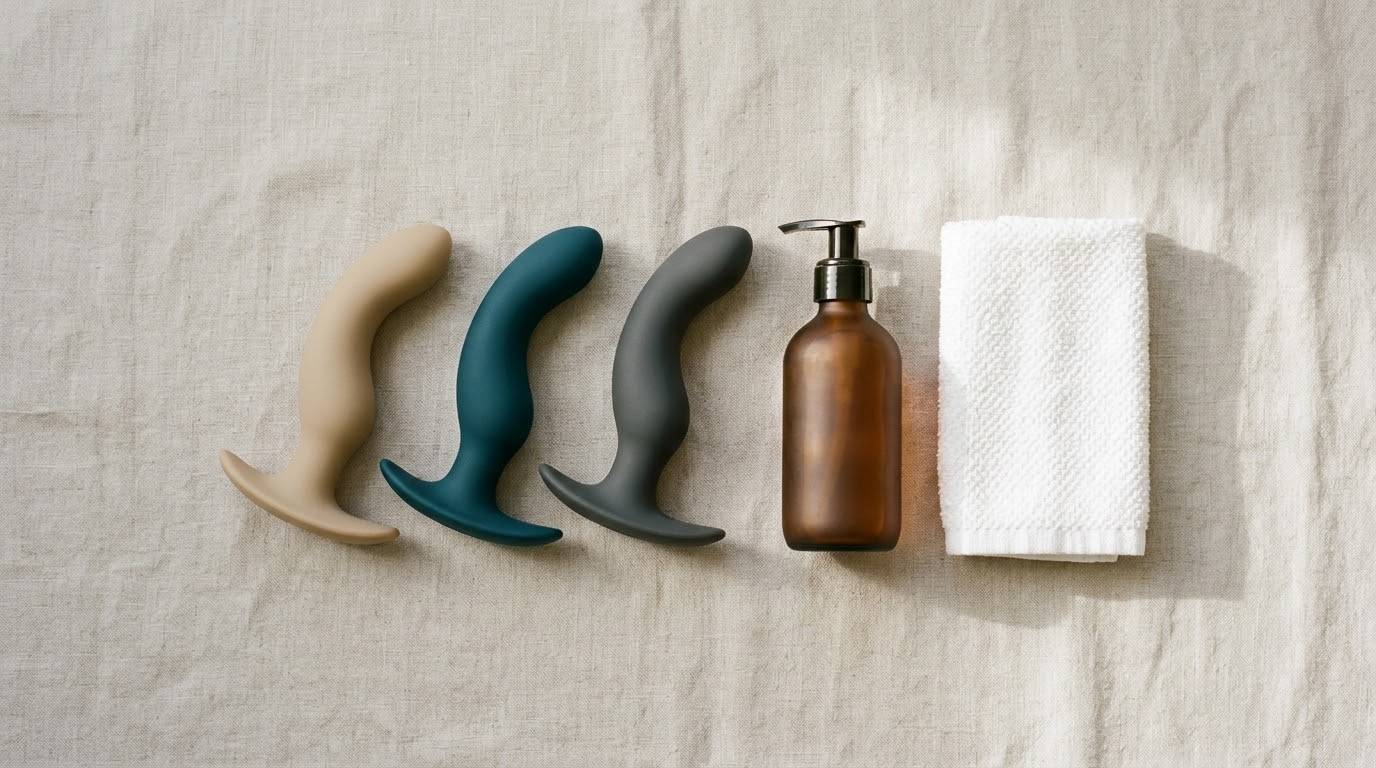
- Use a toy designed for anal use. Use only toys made for anal use, with a flared base or a long handle so they cannot slip inside, made of body-safe silicone, glass or steel. Prostate massagers are curved to reach the gland without effort.
- Clean up and check in afterwards. Wash toys and hands thoroughly, never move from anal to vaginal contact without cleaning or changing the condom on a toy, and pay attention to how your body feels. Pain, bleeding or fever afterwards are reasons to see a doctor.
On lubricant: water-based lubricant works with every toy material. Silicone lubricant lasts longer but can damage silicone toys, so pair it with glass or steel. Avoid numbing lubricants: pain is information you need.
09Housekeeping: preparation, hygiene and aftercare
None of this is glamorous, but it is the difference between an experience you want to repeat and one you do not. If you play with a partner, keep in mind that the same rules that apply to anal sex apply here: consent, communication, hygiene and protection.
Before
- Empty your bowels and shower. For most people that is enough. The rectum is usually close to empty, and the prostate is only a few centimetres in.
- An enema is optional, not required. If it makes you more relaxed, use a small enema bulb with lukewarm saline or plain water about an hour beforehand, so all the water has time to come out. Never use soap, oils, alcohol or household products, use only as much water as a bulb holds, and keep it occasional: frequent douching can damage the lining of the rectum.13
- Nails and hands. Trim and file nails smooth, remove rings, and wash your hands. A nitrile glove is the easy option, especially for self-play: it smooths over nails, keeps cleanup simple, and comes off inside out when you are done.
- Set up the space. A towel underneath, lubricant within reach, wipes and a toy cleaner nearby, and the toilet not far away.
During
- Lots of lubricant, reapplied often. If it starts to feel dry or draggy, add more.
- Condoms on shared toys, changed between partners. Anal play can pass on sexually transmitted infections like any other sexual contact, so a glove or condom is good practice outside a monogamous, tested relationship.
- Never go from anal to vaginal or oral contact without washing, or changing the glove or condom first. Bacteria that are harmless in the rectum can cause infections elsewhere.
- Stay clear-headed. Alcohol, drugs and numbing products blunt the pain signals that tell you to slow down.
- Small accidents happen. A little mess is normal and not a reason for embarrassment. A towel and a sense of humour cover it.
After
- Wash toys straight away with warm water and mild unscented soap or a toy cleaner, following the maker’s instructions for the material, and let them dry fully before storing them separately.
- Wash your hands and the area, even if you used a glove.
- Check in. With yourself or your partner: what felt good, what did not. A little sensitivity afterwards is normal; pain, bleeding or fever are not.
10Choosing a toy
Fingers are a perfectly good place to start. If you want a toy, the market has grown a great deal, and the main types are easy to tell apart.
Classic prostate massager
A curved insertable arm with an external handle that rests on the perineum. Pelvic muscle contractions move it, so it works with no hands at all.
Vibrating massager
The same curved shape with internal and often external vibration. Easier to feel quickly, so popular with beginners.
Small plug with flared base
Not prostate-specific, but a simple way to get used to the sensation. Choose a slim size and a wide, flared base.
External perineum toy
Vibrators or massagers pressed on the perineum. Indirect stimulation with no penetration, good for the cautious or for couples.
Whatever you choose: body-safe materials only (medical-grade silicone, borosilicate glass or stainless steel), always a flared base or long handle, and never anything not designed for anal use. In one hospital review of retained rectal objects, vibrators and dildos made up more than two-thirds of cases, and almost every patient needed the object removed in hospital, most of them under anaesthesia.9 A flared base prevents almost all of that.
11Talking to a partner
For many men the hardest part is not the anatomy but the conversation. A few things make it easier.
- Talk outside the bedroom, in a relaxed moment, as curiosity rather than a request.
- Explain the anatomy. Most partners have never thought about the prostate as a source of pleasure. Sharing an article like this one can do the explaining for you.
- Start external. Perineum massage during foreplay is an easy first step that involves no penetration.
- Massage, do not thrust. A partner’s finger should stay inside and work on the gland, not slide in and out.
- Agree that either of you can stop, at any point, without explanation.
- Debrief afterwards. What felt good, what did not, what you would like to try next time.
Partners are often far more open than men expect. The silence is usually on the side of the person who wants to ask.
12When to stop and see a doctor
Stop immediately if anything is painful. See a doctor if you have bleeding that does not stop quickly, pain that lasts after stimulation, fever or chills, or if a toy or object cannot be retrieved — do not try to remove it with other objects.
Also see a doctor, whether or not you have tried prostate play, if you notice painful or difficult urination, an inability to empty the bladder fully, blood in urine or semen, or pain in the testicles, lower back or the area between the genitals and the anus. These can be signs of prostatitis, an inflammation of the prostate that needs medical treatment.12 Do not attempt prostate stimulation while you have an active prostate infection, a flaring haemorrhoid or an anal fissure.
Curiosity, good taste and no taboos
BentBox is a marketplace for independent creators, photographers and collectors who believe sexuality deserves to be shown with care and honesty. Every creator is verified, and every piece of content is consensual.
Join BentBox For collectors →FAQFrequently asked questions
What is a prostate orgasm?
A prostate orgasm is an orgasm produced mainly by stimulating the prostate gland, either internally through the front wall of the rectum or externally through the perineum. The prostate is surrounded by nerves involved in sexual response, and a scientific review in the journal Clinical Anatomy described prostate-induced orgasms as a real and under-researched phenomenon. People who experience them often describe the sensation as more diffuse and longer-lasting than a penile orgasm.
Where is the prostate and how do you find it?
The prostate is a walnut-sized gland that sits below the bladder and in front of the rectum, wrapped around the urethra. It can be reached a few centimetres inside the anus by pressing towards the front of the body, in the direction of the navel, where it feels like a smooth, rounded bump. It can also be stimulated indirectly by pressing on the perineum, the area between the scrotum and the anus.
Does enjoying prostate stimulation mean you are gay?
No. Sexual orientation is about who you are attracted to, not which parts of your own body give you pleasure. The American Psychological Association defines orientation as an enduring pattern of emotional, romantic or sexual attraction. Research backs this up: a national German survey found that 16 percent of heterosexual men had used anal sex toys, about the same share as heterosexual women, and a UK study of heterosexual men found that many were open to receiving anal stimulation without it affecting their identity.
Is prostate stimulation safe?
For healthy adults it is generally safe when done gently, with plenty of lubricant, trimmed nails or gloves, and toys designed for anal use with a flared base or handle. The main avoidable risks are small tears from going too fast and objects slipping inside, which is one of the most common reasons for rectal foreign body visits to emergency departments. Do not attempt it if you have an active prostate infection, haemorrhoids that are flaring or an anal fissure, and stop if anything hurts.
Is prostate stimulation good for prostate health?
There is no good evidence that prostate stimulation itself prevents prostate disease. What research does show is an association between more frequent ejaculation and a lower risk of prostate cancer: a large Harvard study following nearly 32,000 men found that those who ejaculated 21 or more times a month had about a 20 percent lower risk than those who ejaculated 4 to 7 times a month. That study was observational, so it shows an association rather than proof of cause. A practical benefit is body awareness: knowing how your prostate normally feels can help you notice swelling, firmness or tenderness that is worth showing a doctor.
Can you have a prostate orgasm without ejaculating?
Some men report orgasms from prostate stimulation with little or no ejaculation, and others report a slow release of fluid rather than a typical ejaculation. Experiences vary widely, and research on the subject is still limited, so it is best to explore without expectations rather than aim for a particular result.
Should a finger or toy slide in and out during prostate stimulation?
No. This is the most common misconception. The prostate is stimulated by massage, not by thrusting. Once the finger or toy is inserted and resting on the gland, it should stay inside with the entrance still and relaxed, while you massage the prostate with a slow come-hither curl, small circles, pressure held and released, or gentle side-to-side sweeps. Thrusting mostly stimulates the entrance, is more likely to cause discomfort, and barely reaches the prostate.
Can prostate stimulation help you notice a swollen prostate?
Yes, and it is worth doing. Prostate self-awareness works like breast self-awareness for women: by knowing how your prostate normally feels, you can notice changes such as enlargement, a hard area or lump, asymmetry or new tenderness, and show them to a doctor early. Prostate enlargement is common with age, affecting about a third of men over 65 according to the US National Institutes of Health. It does not replace a doctor's examination or recommended screening, because many prostate problems cannot be felt at home, but it can get you to a doctor sooner.
Do I need an enema before prostate play?
No, but many people prefer one. Showering and emptying your bowels is usually enough, and a glove makes self-play cleaner. If you want an enema, use a small bulb with lukewarm saline or plain water about an hour beforehand, never soap, oils or household products, and do not douche more than occasionally, because overdoing it can irritate the lining of the rectum.
What kind of toy is best for prostate stimulation?
A curved prostate massager made of body-safe silicone, with a flared base or an external arm that rests against the perineum, is the usual starting point. Begin with a slim size, use a lubricant compatible with the toy material (water-based lubricant is safe with silicone toys), and avoid anything not designed for anal use.
How do I bring up prostate play with a partner?
Raise it outside the bedroom, in a relaxed moment, as curiosity rather than a request. Explain what it is and why you are interested, share an article if that helps, and agree that either of you can stop at any point. Starting with external perineum massage is an easy, low-pressure first step for couples.
When should I see a doctor?
See a doctor if you have pain, bleeding, fever or chills after stimulation, if a toy or object cannot be retrieved, or if you notice symptoms such as painful or difficult urination, blood in urine or semen, or pain between the genitals and anus. These can be signs of injury or prostatitis, which needs medical treatment.
SOURCESReferences
- Michael Reece et al.. Prevalence and Characteristics of Vibrator Use by Men in the United States. The Journal of Sexual Medicine, 2009 (reported by ScienceDaily).
- Nicola Döring and Sandra Poeschl. Experiences with Diverse Sex Toys Among German Heterosexual Adults: Findings from a National Online Survey. The Journal of Sex Research, 2020.
- National Cancer Institute, SEER Training. Anatomy of the Prostate. U.S. National Institutes of Health.
- StatPearls. Anatomy, Abdomen and Pelvis: Anal Canal. StatPearls Publishing.
- Roy J. Levin. Prostate-induced orgasms: A concise review illustrated with a highly relevant case study. Clinical Anatomy (Wiley), 2018.
- American Psychological Association. Understanding sexual orientation and homosexuality. APA.
- Liam Wignall, Ryan Scoats, Eric Anderson and Luis Morales. A Qualitative Study of Heterosexual Men's Attitudes Toward and Practices of Receiving Anal Stimulation. Culture, Health & Sexuality, 2019.
- Jennifer R. Rider et al.. Ejaculation Frequency and Risk of Prostate Cancer: Updated Results with an Additional Decade of Follow-up. European Urology, 2016.
- Abraham A. Ayantunde and Zeynep Unluer. Increasing trend in retained rectal foreign bodies. World Journal of Gastrointestinal Surgery, 2016.
- Cedars-Sinai. Breast Self-Awareness. Cedars-Sinai.
- National Institute of Diabetes and Digestive and Kidney Diseases. Enlarged Prostate (Benign Prostatic Hyperplasia). U.S. National Institutes of Health.
- MedlinePlus Medical Encyclopedia. Prostatitis - acute. U.S. National Library of Medicine.
- San Francisco AIDS Foundation. Anal douching safety tips. SFAF.
This article is for general education about sexual wellness and is not medical advice. If you have symptoms or concerns about your prostate, please speak to a doctor.