
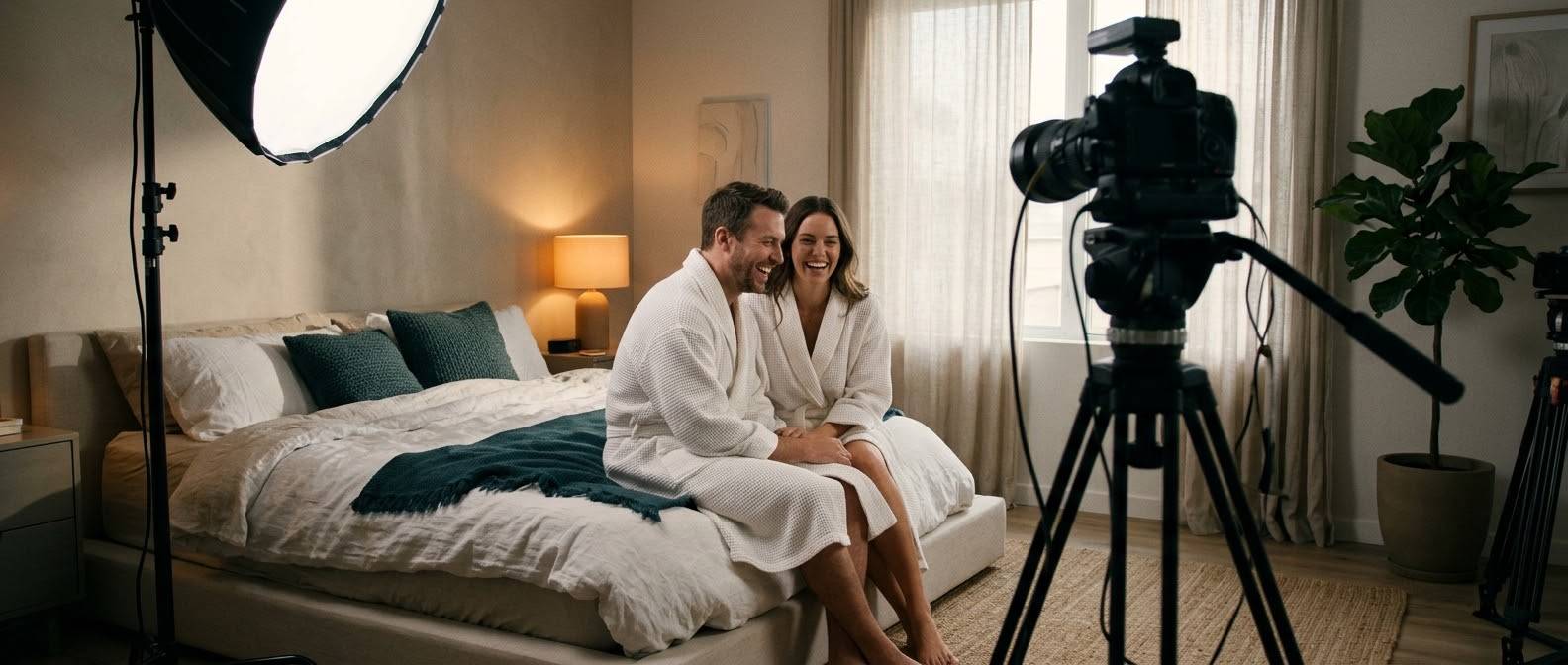
Filming yourselves is the most private way to make intimate video: no crew, no third person in the room, and nothing leaves your hands until you decide it should. It is also unforgiving. Video shows every distortion, every unflattering shadow and every bad camera position for minutes at a time, where a photograph would hide it in a single good frame.
The good news is that almost every problem in amateur footage comes from a short list of avoidable mistakes, and none of the fixes require expensive equipment. This guide covers them in the order that matters: consent and paperwork, kit and settings, then the part most people get wrong — where to put the camera, which lens to use, and how to frame two bodies so the result looks intentional rather than accidental.
The short version
- Put the camera at chest height, at a three-quarter angle, a few metres back.
- Never use the ultra-wide lens close to bodies. Step back and use a normal lens.
- Turn off the ceiling light. One soft source from the side does the work.
- Lock exposure, white balance and focus before you start.
- Shoot in short beats and check the footage between them.
- Every performer is a verified adult with a signed release, before anything is filmed.
01Start with consent and paperwork
Before anything technical: a video you can sell starts with a conversation, not a camera. Agree what you are filming, what will be published, where it will be published, and what stays private. Agree that either of you can stop the recording at any moment without needing a reason, and that footage either of you is unhappy with afterwards does not get released.
Then do the paperwork while you are both calm and clothed. Every person on camera must be an adult with valid ID, and every performer needs a signed release form. Doing this first rather than after the shoot means nobody is asked to sign something in the awkward moment after filming, and it means the footage is publishable the moment it is edited.
Filming with your partner still needs clear consent
Being a couple does not make consent automatic. Agreeing to be intimate is not the same as agreeing to be filmed, and agreeing to be filmed is not the same as agreeing to be published. Before every shoot, both of you should be clear on three things: what will be filmed, where it will be posted, and who will be able to see it. Revisit that agreement when anything changes — a new platform, a new kind of scene, or a change in the relationship.
On BentBox, your partner must be verified as a co-performer, with their own identity check (KYC) linked to the content posted on your account. It takes a few minutes: your partner can verify their identity for BentBox content from the settings page of your account. Once verified, they are recorded as a consenting co-performer for the content you post together.
On BentBox, sexual content is only accepted when it is consensual and covered by a release for each person who appears. A partner who appears regularly verifies once as a co-performer from your settings. Anyone else who appears needs their own release; ProntoID issues a Form ID for each one, which you attach to the listing.
02The kit you actually need
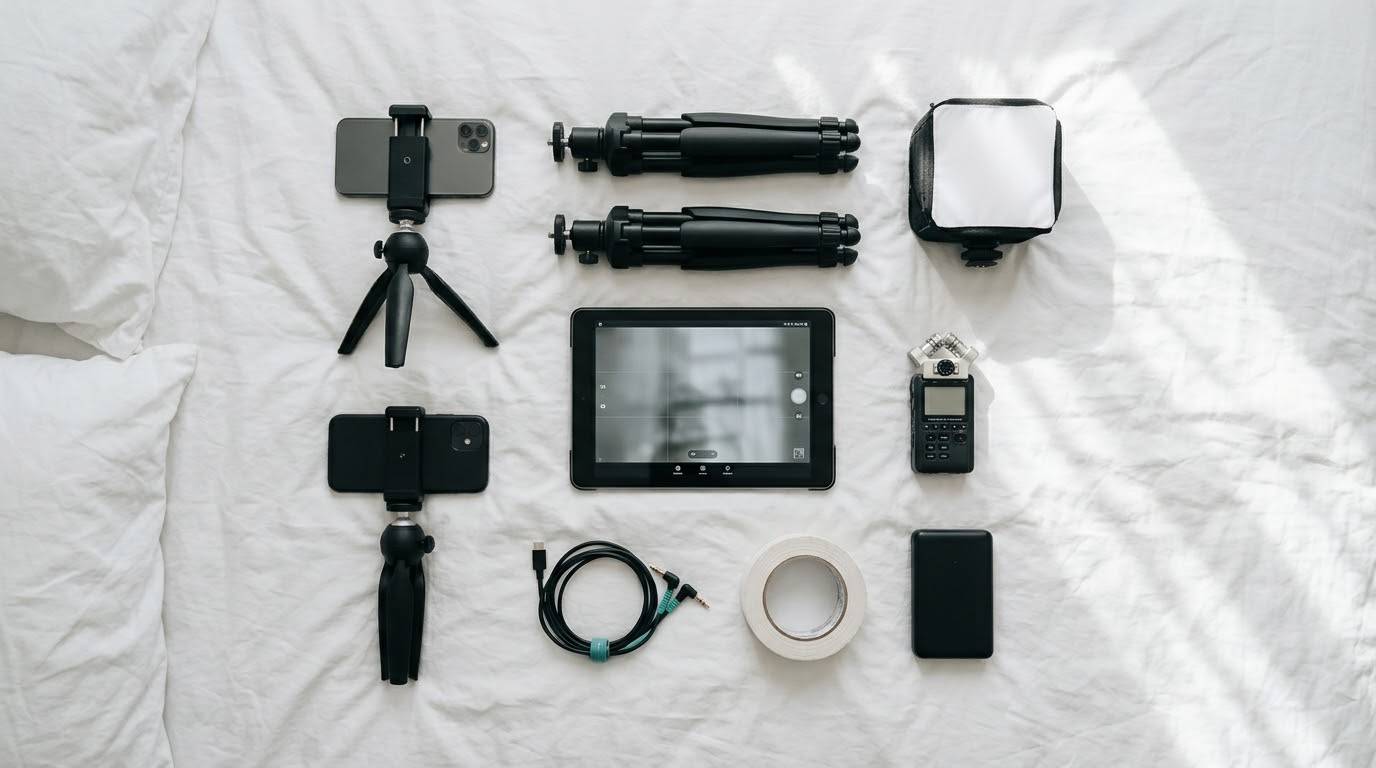
Less than you think. A recent phone produces video that sells perfectly well; buyers respond to composition, light and chemistry far more than to sensor size. What matters is that the camera is stable, that you can see the frame from where you are, and that you have more than one angle.
- Two cameras, ideally. One locked-off wide master that never moves, and one for closer shots. Two phones are a perfectly good two-camera setup.
- A real tripod for the master, tall enough to reach chest height. A phone clamp on a sturdy tripod beats any bendy mini-tripod.
- A monitor you can see. Most camera apps can mirror live view to a second phone or tablet. Prop it just outside the frame.
- One soft light — a window with a sheer curtain, or an LED panel through a diffuser.
- A separate sound source. A spare phone with a voice-memo app, close to the action and out of frame, is a big step up from a camera microphone across the room.
- Plenty of storage and power. Running out of either mid-session is the most avoidable way to lose a take.
03Settings that matter
Automatic modes are designed for footage where nothing important is happening. In intimate video, bodies move constantly in and out of light, and auto settings respond by brightening, darkening, shifting colour and hunting for focus — all of which is visible and distracting. Set these once and lock them.
| Setting | Use | Why |
|---|---|---|
| Frame rate | 24, 25 or 30 fps | Natural motion. Use the same rate on every camera so they cut together. |
| Shutter speed | About double the frame rate | The 180-degree shutter rule: 1/50 at 25fps gives natural motion blur.1 In Europe, 1/50 or 1/100 avoids flicker from mains-powered lights; in North America use 1/60 or 1/120.2 |
| Resolution | 4K if your device handles it | Lets you crop and reframe in the edit without losing quality. |
| White balance | Fixed, never auto | Auto white balance shifts skin tone as bodies move. Pick daylight or the preset that matches your light. |
| Exposure | Locked | Stops the picture pumping brighter and darker as skin and bedding move through the frame. |
| Focus | Locked, or reliable face tracking | Focus hunting is the most common reason footage is unusable. |
For focus, the reliable method is the one self-shooting photographers use: mark the position on the bed or floor, focus on something at that distance, then lock focus. A moderate aperture, or a phone's standard lens rather than a portrait mode, gives enough depth of field to absorb movement. Cinematic background blur looks wonderful in a still and terrible when someone moves ten centimetres and drops out of focus.
04Camera angles that flatter the body
Camera height and angle change body proportions more than anything else you control. The principle is simple: the camera exaggerates whatever is closest to it and shrinks whatever is furthest away. Every flattering angle is an application of that rule.
None of this is new. Joseph Mascelli opens The Five C's of Cinematography, still one of the standard texts on film technique, with camera angles, because where the camera stands decides how the audience reads everything in front of it.3 The same principles that shape a feature film shape a bedroom video.
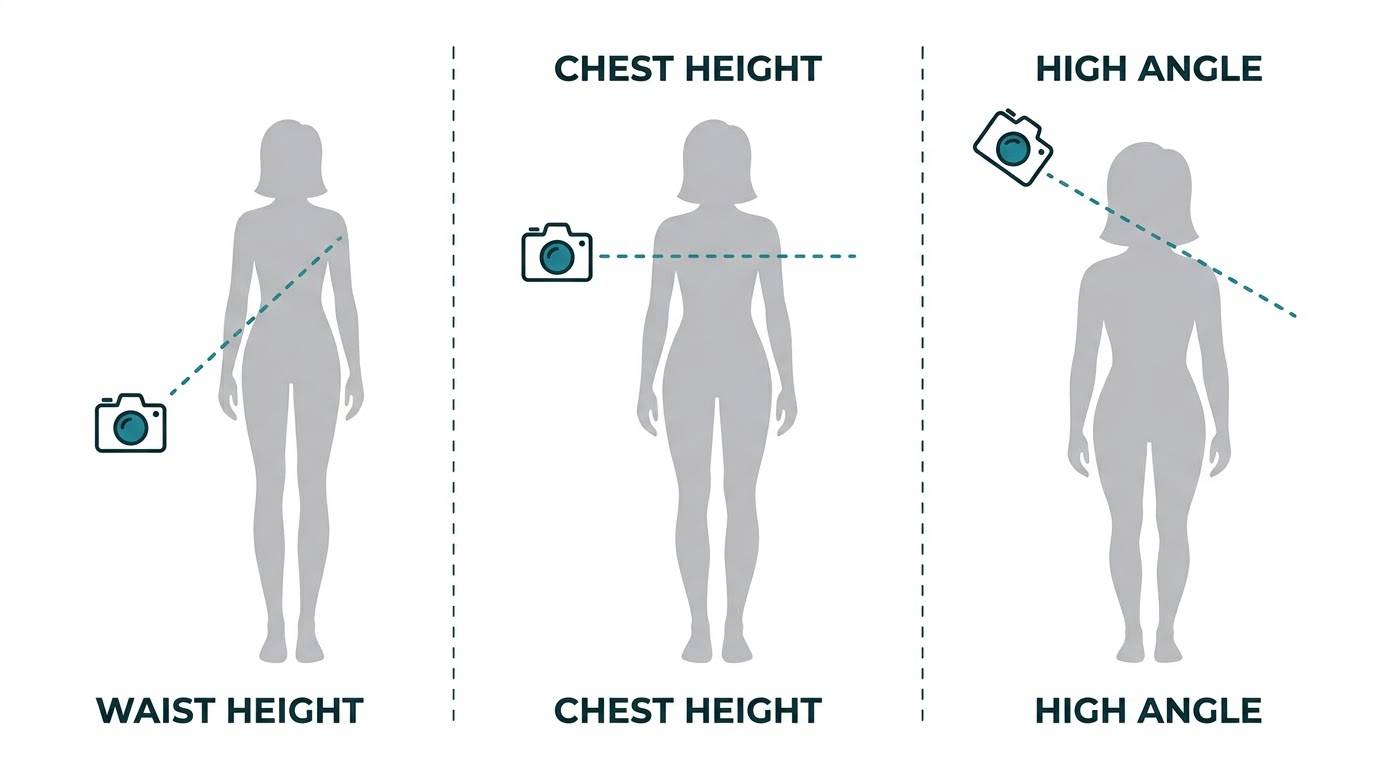
Height: chest height as the default
For a wide master shot, put the lens at roughly the chest height of the performers. It is neutral: legs are the right length, faces are not foreshortened, and you can see both people clearly. From there, small adjustments change the look.
- Lower, toward waist height, lengthens legs and makes a standing body look taller. Go too low and hips and thighs become the nearest and largest thing in the frame.
- Slightly above eye level is flattering for faces and necks, and defines the jawline. Go much higher and the body shortens, the head grows and legs disappear.
- Directly overhead works for a deliberate graphic shot of two people lying down, but as a main angle it flattens everyone and hides expression.
Direction: three-quarter, not square-on
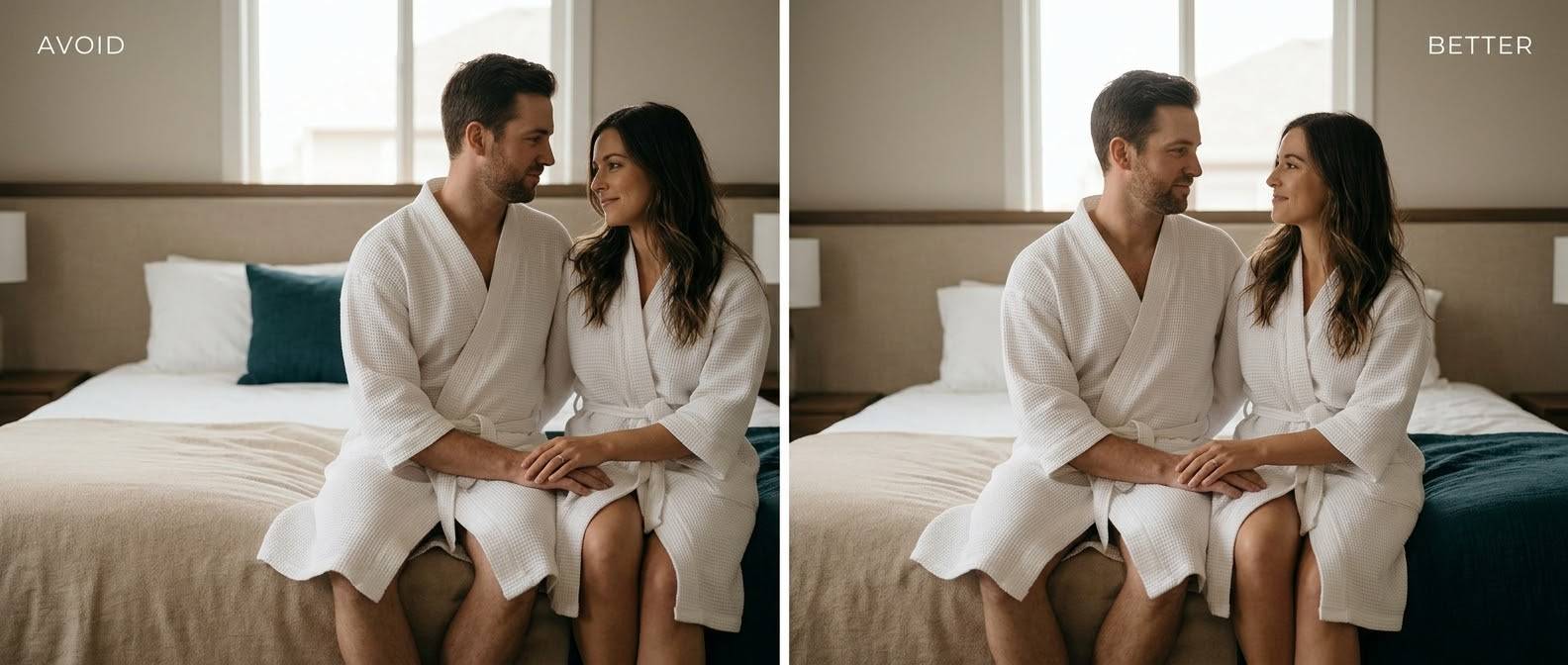
A camera pointed square at someone shows the widest version of their body. Turning either the body or the camera so you see it at about 45 degrees narrows the waist, adds shape through the hips and shoulders, and gives depth. For two people, a three-quarter angle also separates them, so you see two bodies rather than one shape.
Keep the camera level. Tilting the lens up or down on a wide shot makes vertical lines converge, which makes rooms look crooked and bodies look stretched or squashed at the edges of the frame.
Do
- Chest height for the master
- Three-quarter angle to the bodies
- Camera level, lens a few metres back
- Lower slightly to lengthen legs
- Shoot along the line of the body
Avoid
- A phone propped low on a bedside table
- Square-on to the widest part of the body
- Steep downward angles from standing height
- Ultra-wide lens close to anyone
- Feet or knees closest to the lens
05Lenses and distance: the single biggest fix
If you change one thing after reading this, change this. Most amateur intimate video is shot with a wide lens from very close — a phone held at arm's length, or propped half a metre from the bed. A wide lens up close enlarges whatever is nearest and shrinks everything behind it, so noses, hands, knees and feet balloon while the rest of the body recedes. This is called perspective distortion, and it is the main reason footage looks unflattering even when the people in it are not.
The fix is to move the camera further back. Strictly, the distortion comes from the camera's distance, not from the lens itself: from half a metre away, a knee is far closer to the camera than a shoulder, while from three metres the difference barely registers.4 A longer focal length is simply what lets you fill the frame from that further position. Somewhere between 35mm and 85mm full-frame equivalent works well, and around 50mm feels closest to how the eye sees, which is why portraits are traditionally shot in that range.
- On a phone, use the main lens or the 2x/3x telephoto lens, never the 0.5x ultra-wide for bodies. Step back rather than pinching to zoom, since digital zoom throws away quality.
- On a camera, a 50mm or a 24–70mm zoom at the long end is ideal. Fit the room by moving the tripod, not by widening the lens.
- If the room is small, shoot from the doorway or the corner furthest from the bed. A slightly tighter frame from further back is better than a wide frame from close.
The camera enlarges whatever is nearest to it. Move it back, use a normal lens, and most of what looked wrong with your footage disappears.
06Clear framing for two people
Framing two moving people is harder than framing one, because bodies overlap and positions change constantly. Clarity is the goal: the viewer should always be able to read who is where and what is happening.
- Pick the side with the least overlap. Before you start, walk around the set and find the angle where both bodies stay most visible through the planned positions. That is where the master goes.
- Frame a little wider than the action on the master. People move further than they expect, and 4K lets you crop in later. A limb disappearing off the edge of frame looks careless.
- Do not crop at joints. Frame edges that cut through knees, elbows, ankles or wrists look like amputations. Cut mid-thigh, mid-upper-arm or mid-shin instead.
- Leave room in the direction of movement and above the head when someone sits up, so nobody is pressed against the frame edge.
- Keep faces in the story. Expression is what separates intimate video that sells from footage that does not. If faces will not be shown, make that a deliberate framing choice from the start rather than an accident of camera position.
- Mind the background line. A headboard, window frame or wall edge cutting through someone's head or neck is distracting. Shift the camera slightly to move it.
Decide the orientation before you shoot. Horizontal is the standard for full videos and for watching on a screen. If you also want vertical clips for social teasers, frame the horizontal master with the action centred so you can crop a vertical out of it, or set the second camera vertical from the start.
07The four shots that make a video
Video that holds attention cuts between different distances. Film crews call this coverage: a master shot of the whole scene, plus closer angles of the same action, so the editor always has a choice of shot.5 With two cameras and a plan, you only need four kinds of shot to edit something that feels produced rather than recorded.
Wide master
The whole set, locked off at chest height and a three-quarter angle. It runs the entire time and is your safety net: whenever a closer shot fails, cut back to this.
Medium
Waist or mid-thigh up, showing both people and their expressions. Most of a good edit lives here; it is where chemistry is visible.
Close detail
Hands, faces, skin, fabric. Short shots that add texture and give you somewhere to cut. Keep the lens at a normal focal length and move it, not the zoom.
Point of view
Held by one partner. Hold the phone with both hands close to the body, move slowly, and use stabilisation. Use sparingly, as long handheld sequences tire viewers.
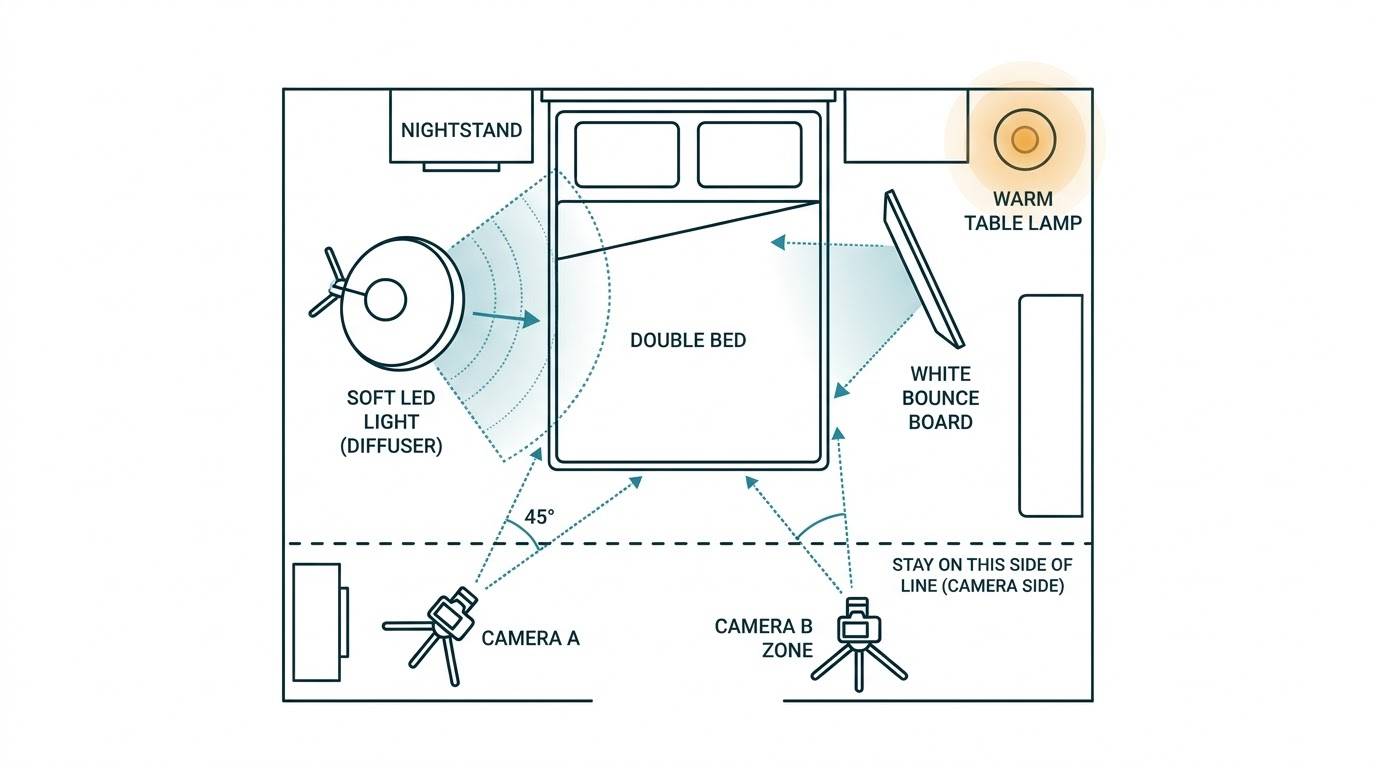
Keep the second camera on the same side of the action as the master. This is the 180-degree rule, also called the axis of action: imagine a line running through the two performers, and keep every camera on one side of it.6 If a camera crosses the line, movement that went left to right on one camera goes right to left on the other, and the edit becomes disorienting.
08Lighting at home
Ceiling lights are the enemy. Light from directly above puts dark shadows under eyes, cheekbones and every curve of the body, and it is the default in most bedrooms. Turn it off and replace it with one large soft source from the side.
- Key light: a window with a sheer curtain during the day, or an LED panel through a diffuser or softbox. Place it to one side of the bed, slightly above the performers and angled down a little. The larger the source relative to the performers, the softer the light, so moving it closer softens it further.7
- Fill: a white wall, white sheet or bounce board on the opposite side lifts the shadows without adding a second light to manage.
- Atmosphere: a warm table lamp or string lights in the background — what cinematographers call practicals — add mood and depth.5 Keep them in the background, not lighting the performers.
- One colour on skin. Daylight from a window and warm household bulbs on the same body produce orange and blue patches no edit can fix. Choose one and match the camera's white balance to it.
Light coming from behind the camera and slightly to one side is the most forgiving. Light from directly behind the performers gives a beautiful rim and silhouette but leaves faces dark; use it for a deliberate moment, not the whole video. Avoid bare bright bulbs in the frame, which phones render as blown-out white blobs.
09Sound
Viewers forgive soft focus sooner than bad sound. Hum, echo, a fridge, traffic or a notification ping break the atmosphere instantly, and they are almost impossible to remove later.
- Turn off fans, air conditioning, heaters with fans, and anything that hums. Put every phone not being used as a camera into silent mode.
- Soft furnishings absorb echo. Bedding, curtains and a rug make a big difference in a bare room.
- Record sound on a separate device close to the action but out of frame, then sync it in the edit with a clap at the start of each beat.
- Record a minute of the room's silence before you start. Editors use it to smooth over gaps and cuts.
- Do not add commercial music. Copyrighted tracks get videos removed and cannot be licensed for this use. Natural sound is usually better anyway; if you want music, use tracks whose licence clearly covers adult content.
10Directing yourselves
The hardest part of filming yourselves is that nobody is watching the monitor while you are in the scene. A small amount of planning replaces the director you do not have.
Plan in beats. Break the video into a handful of positions or moments and write them down. Record each beat separately, from start to natural end. Short beats are easier to frame, easier to repeat if something goes wrong, and much easier to edit.
Block before you roll. Walk through each position clothed, with the cameras running, and check the frame on the monitor. Mark positions on the bed with something discreet, so you return to the spot the camera is framed and focused for.
Review between beats. Watch back a few seconds of each beat on both cameras: framing, focus, exposure, and whether anything identifying crept into the frame. Fix it before the next beat, not after you have packed up.
Stay present. Checking the camera mid-scene kills the mood and shows on camera. Set up well enough that you can forget about the equipment during each beat; that is what the planning is for. Chemistry is the product, and the technique only exists to show it clearly.
11Editing
Any modern editor handles this, including free ones and phone apps. A few principles make a large difference.
- Sync your cameras and sound using the clap at the start of each beat, then cut between angles. A cut every several seconds to a different distance keeps attention; a single locked-off angle for twenty minutes rarely does.
- Cut for feeling first. Walter Murch, the Oscar-winning editor of The English Patient, ranks emotion above every technical rule when deciding where to cut.8 For intimate video, cut to whichever angle best shows what the two of you are feeling, even if another angle is technically cleaner.
- Trim dead time ruthlessly: repositioning, adjusting the camera, the first and last seconds of each beat.
- Match colour between cameras so skin looks the same on both. Two different phones rarely match out of the box.
- Grade gently. A touch of warmth and contrast helps; heavy filters date quickly and look amateur.
- Export a clean master at the resolution and frame rate you shot at, then make shorter cuts from it.
- Cut a safe-for-work teaser of a few seconds, plus a glamour still for the cover. These are what you show publicly.
12Privacy and metadata
Intimate video made at home contains your home, for minutes at a time, from several angles. That is far more opportunity for an accidental disclosure than a single photograph.
- Strip metadata from video files. Phones can record location and device details into video files just as they do into photos. Re-exporting from an editor usually removes it, but verify rather than assume.
- Check every angle, not just the master. The second camera and handheld shots see parts of the room the master does not.
- Watch for reflections in mirrors, windows, TV screens, glossy furniture and picture glass. They can show the room, the camera, or a face you did not intend to show.
- Clear the background: post, packaging, documents, photographs, distinctive artwork, a recognisable view through a window.
- Mind the sound. Names spoken aloud, a phone ringing with a caller name, a recognisable local noise.
- Decide about identifiers deliberately. Tattoos, birthmarks and everyday jewellery identify people as reliably as faces.
- Store raw footage carefully, encrypted and not in an automatically synced photo library you share with anyone else.
On BentBox, identity verification is private and never shown to buyers. You can be fully anonymous to your audience — faces cropped, no names — while every performer is verified to the platform.
13Turning footage into something that sells
Buyers of couple content are paying for chemistry shown clearly: two people who are visibly into each other, lit and framed so you can see it. Consistency matters as much as any single video, so a repeatable set and a recognisable look build an audience faster than occasional ambitious productions.
On BentBox you list the finished video in a Box, on its own or alongside stills from the same session, and set your own price. For Boxes you keep one hundred percent of that price, because the BentBox fee is added on top and paid by the buyer. Attach the release Form ID for every performer, and choose which countries and US states can see the listing.
Keep the full video inside the Box. The public cover should be a glamour image and the teaser should be safe for work — which is also exactly what you need for promoting on social platforms, where adult material is not allowed. You can keep adding to a Box after it sells, and existing buyers get the new material automatically, which makes a series of videos from the same set a good way to reward the people who bought first.
14The process, start to finish
- Agree consent and paperwork first. Talk through what will be filmed, what will be published and where, and agree that either of you can stop recording at any point. Make sure every person on camera is an adult with ID to hand, and complete a release form for each performer before you shoot, not afterwards.
- Prepare the room, remove identifiers. Clear the background, make the bed or set properly, and remove anything that identifies you or your home: post, photographs, documents, distinctive artwork, screens and views through windows. Warm the room so nobody is tense or covered in goosebumps.
- One soft light, no mixed colour. Use a window with a sheer curtain or one LED panel through a diffuser as your key light, placed to the side and slightly above. Turn off overhead ceiling lights and avoid mixing daylight with warm bulbs, which produces skin tones you cannot fix in editing.
- Lock exposure, white balance, focus. Set the frame rate, a shutter speed of roughly double the frame rate, and a fixed white balance, then lock exposure so the image does not pump as bodies move through the light. Use reliable face or eye tracking autofocus, or manual focus on a marked position with a moderate aperture for depth of field.
- Set a wide master camera. Put your main camera on a tripod at roughly chest height to the performers, at a three-quarter angle to the bed or set, using a normal or short telephoto focal length from further back rather than a wide lens up close. This angle captures the whole scene with natural proportions and never needs touching.
- Add a second, closer angle. A second camera, handheld or on a small tripod, gives you medium and close shots to cut to. Keep it on the same side of the action as the master so movement direction stays consistent when you edit between them.
- Shoot in beats, review between. Plan the video as a handful of positions or moments, record each as its own beat, and check the footage between beats for framing, focus and light. Short beats are easier to repeat, easier to edit, and keep the session relaxed.
- Record clean sound. Turn off fans, air conditioning and notification sounds, put a phone or small recorder close to the action but out of frame, and record a minute of room silence for editing. Do not add commercial music, which gets videos removed and cannot be licensed for adult use.
- Edit, strip metadata, cut a teaser. Cut between your angles, trim dead time, match colour between cameras, and export a clean master. Remove location and device metadata from every file, and cut a short safe-for-work teaser and a glamour cover image for public use.
- Upload with every release attached. Attach the release form for each person who appears, set your price and the regions that can see the listing, and use the safe-for-work teaser and cover publicly while the full video stays inside the paid listing.
Sell what you film together, and keep all of it
List your videos in Boxes, set your own price, and keep 100% of it — the fee is added on top and paid by the buyer. Verified privately, anonymous publicly, non-exclusive, with release forms for every performer handled through ProntoID.
Become a BentBox creator Verify your partner as a co-performer →FAQFrequently asked questions
What is the most flattering camera angle for intimate video?
A camera at roughly chest height, positioned at a three-quarter angle to the performers rather than square on, and placed a few metres back with a normal or short telephoto lens. Square-on angles flatten the body, very high angles shorten legs and torso, and very low angles exaggerate whatever is nearest the lens. Lowering the camera slightly toward waist height lengthens legs, and turning the body a little away from the lens narrows the waist and gives shape.
Which lens or focal length is best for filming bodies?
A focal length between about 35mm and 85mm full-frame equivalent, used from further back. Wide lenses used close up enlarge whatever is nearest the camera and shrink everything behind it. This is perspective distortion, and it is caused by camera distance, so stepping back is the real fix and a longer lens is what lets you fill the frame from there. On a phone, use the main or 2x lens rather than the ultra-wide, and step back instead of zooming digitally.
How do you frame two people clearly in one shot?
Keep both faces or both bodies readable in the frame, leave a little space in the direction of movement, avoid cutting the frame at joints such as knees, elbows and ankles, and shoot from the side where the bodies overlap least. A three-quarter angle on the master camera usually separates two people better than a front-on or overhead angle, and a second camera gives you clean closer shots so the wide frame does not have to do everything. Keep both cameras on the same side of the performers, following the 180-degree rule, so movement direction stays consistent when you cut.
What camera settings should I use for video?
Record at 24, 25 or 30 frames per second in the highest resolution your camera handles comfortably, with the shutter speed at roughly double the frame rate, such as 1/50 at 25fps. In Europe 1/50 or 1/100 avoids flicker from mains-powered lights, and in North America 1/60 does the same. Fix the white balance rather than leaving it on auto, and lock exposure so the image does not brighten and darken as you move. Recording in 4K lets you crop and reframe when editing.
How can a couple film without a camera operator?
Use a locked-off wide master camera that covers the whole set and never needs touching, plus an optional second camera on a small tripod or held by one partner for closer shots. Mark positions on the bed or floor, check framing on a phone or tablet monitor before you start, plan the video in short beats, and review the footage between beats. Many cameras and phones can be started and stopped from a remote or app, so nobody needs to leave the set.
What is the best lighting for filming at home?
One large soft source to the side and slightly above the performers, such as a window with a sheer curtain or an LED panel through a diffuser, with a white wall or sheet opposite to soften shadows. Turn off overhead ceiling lights, which create harsh shadows under eyes and across bodies, and avoid mixing daylight with warm household bulbs. A warm practical lamp in the background adds atmosphere without lighting the performers.
How do we protect our privacy when filming intimate video?
Remove location and device metadata from every exported file, check the background for post, documents, photographs, screens and recognisable views, and watch for reflections in mirrors, windows and glossy surfaces. Tattoos, birthmarks and jewellery identify people as reliably as faces, so decide deliberately whether they appear. On BentBox, identity verification is private and never shown to buyers, so you can stay anonymous to your audience while being verified to the platform.
What paperwork do we need to sell intimate video?
Every person who appears must be an adult whose identity has been verified, and each performer needs a signed release form before the content is sold. On BentBox, sexual content is only accepted when it is consensual and covered by a release, and ProntoID generates a Form ID for each release that you attach to the listing. Filming with a partner still requires clear consent about what is filmed and where it is posted, and your partner must verify their identity as a co-performer on your account, which they can do from the BentBox settings page.
How do I sell the videos we shoot?
List the finished video inside a Box, on its own or together with stills from the same session, set your own price, and attach the release forms for everyone in it. For Boxes, you keep one hundred percent of your price, because the BentBox fee is added on top and paid by the buyer. Use a glamour cover image and a safe-for-work teaser publicly, keep the full video inside the Box, and choose which countries and US states can see the listing.
SOURCESReferences
- StudioBinder. What Is the 180-Degree Shutter Rule — And Why It Matters. StudioBinder.
- Sony. How to reduce camera flickering. Sony Support.
- Joseph V. Mascelli. The Five C's of Cinematography: Motion Picture Filming Techniques. Silman-James Press.
- Wikipedia. Perspective distortion. Wikipedia.
- Blain Brown. Cinematography: Theory and Practice (4th edition). Routledge.
- Jessica Livingstone and Mischa Livingstone. No-Nonsense Filmmaking — Screen Direction. Loyola Marymount University (Pressbooks).
- Wikipedia. Hard and soft light. Wikipedia.
- Walter Murch. In the Blink of an Eye: A Perspective on Film Editing (2nd edition). Silman-James Press.