

BDSM is the most mainstream kink there is. Most people have heard the word, many have fantasised about something on its menu, and a surprising number have tried it. Yet it is still widely misunderstood: as dangerous, as a sign of trauma, or as a series of scenes from a film. This guide explains what it actually is, what science says about the people who practise it, and how to explore it with care.
The short version
- BDSM covers bondage and discipline, dominance and submission, and sadism and masochism, between consenting adults.
- It is common: around one in five US adults has tried bondage, and most people have fantasised about dominance or submission.
- It is not a mental disorder. The WHO removed consensual sadomasochism from its diagnostic manual.
- Negotiation, safewords and aftercare are what separate BDSM from abuse.
- Start light, build slowly, keep safety shears close, and never play with anything around the neck.
01The Fifty Shades effect
When Fifty Shades of Grey appeared, BDSM moved from specialist shops and private clubs to supermarket shelves. The trilogy sold more than 100 million copies in 51 languages within a few years,1 followed by three films. Suddenly, blindfolds, ties and the idea of a dominant partner were part of ordinary conversation.
That visibility did real good: it gave many people words for desires they had kept to themselves. But the books are a romance novel, not a manual, and many practitioners dislike how they portray the subject. One academic analysis of the first book found patterns of intimate partner violence in the central relationship, including stalking, intimidation and isolation.2 Critics in the BDSM community point to the same problem from a different angle: in real BDSM, the things that make a scene safe — open negotiation, limits both partners set, the freedom to stop — come first, not as an afterthought.
Fifty Shades made BDSM visible. Real BDSM starts where the novel is weakest: with a conversation about consent.
02What BDSM actually means
BDSM is an umbrella term built from three overlapping pairs of letters. It describes a wide range of consensual activities involving restraint, power and intense sensation, and nobody is expected to enjoy all of them.
Bondage and discipline
Restraint with cuffs, rope or ties, and rules with consequences agreed in advance. Often the entry point for couples.
Dominance and submission
A consensual exchange of power, from a single evening’s role-play to an ongoing dynamic. It may involve no physical activity at all.
Sadism and masochism
Giving or receiving intense sensation, such as spanking, biting or impact play, for pleasure. Intensity is always agreed and adjustable.
Dominant, submissive, switch
The person leading is the dominant or top; the person receiving is the submissive or bottom. A switch enjoys both roles.
Two things surprise people new to the subject. First, BDSM is not necessarily about pain: for many, the appeal is trust, surrender, control or simply the heightened attention of a planned scene. Second, it is not always sexual. Some people experience it as intensely intimate without any sexual activity at all.
03How common it is
BDSM is often treated as niche. The data says otherwise.
of US men and 21% of women have tied up a partner or been tied up during sex3
US adults have spanked or been spanked during sex3
of women and 81% of men in a survey of 4,000+ Americans have fantasised about being dominated4
A nationally representative survey of US adults found that about one in five had tried bondage and roughly a third had tried spanking during sex, while smaller numbers had tried playful whipping.3 Fantasies are even more widespread. In psychologist Justin Lehmiller’s survey of more than 4,000 Americans, fantasies about being dominated, dominating someone and being tied up were reported by large majorities of both women and men.4 A Canadian study of more than 1,500 adults reached a similar conclusion: fantasies of submission and dominance are common, not unusual.5
In other words, an interest in BDSM is close to the norm. The gap between how many people fantasise about it and how many act on it is mostly a gap in information and confidence — which is what this article is for.
04What research says about people who practise it
The old stereotype says people who enjoy BDSM must be damaged in some way. The research does not support it.
A study by researchers at Tilburg University compared 902 Dutch BDSM practitioners with 434 people who did not practise BDSM. The practitioners were, on average, less neurotic, more extraverted, more open to new experiences, more conscientious and less sensitive to rejection, and they reported higher subjective wellbeing. They were also slightly less agreeable. The authors suggested BDSM is better understood as a form of recreational leisure than as an expression of psychopathology.6 That is a correlation, not proof that BDSM makes anyone healthier, but it firmly contradicts the idea that it is a symptom of something wrong.
Medicine has caught up. When the World Health Organization revised its International Classification of Diseases for ICD-11, it removed consensual sadomasochism and fetishism as diagnoses, because there was no evidence they were linked to poor psychological or social functioning and labelling them as disorders only added stigma. The diagnosis that remains, coercive sexual sadism disorder, specifically excludes consensual activity: it concerns harm to people who have not agreed to it.7
The line medicine draws is consent. Consensual BDSM between adults is a variation in sexual interest. Inflicting suffering on someone who has not agreed is not BDSM at all.
05Consent: SSC, RACK and negotiation
Because BDSM deliberately plays with power, restraint and intensity, it has developed more explicit consent practices than most ordinary sex. Two frameworks are widely used.
- SSC — Safe, Sane, Consensual. The older motto: activities should be physically safe, undertaken with a clear mind, and agreed by everyone involved.
- RACK — Risk-Aware Consensual Kink. A newer framing that acknowledges no activity is entirely without risk, and asks partners to understand the risks they are taking and accept them knowingly.
In practice, both lead to the same habits. Negotiate before playing: what each person wants, what they do not, and what they might try. Distinguish hard limits, which are never crossed, from soft limits, which might be explored carefully later. Agree a safeword, and remember that consent can be withdrawn at any moment, by either partner, without explanation.

06Myths and facts
07Getting started, step by step
The best first experiences are small, planned and talked about. Intensity can always be increased next time.
- Talk first, outside the bedroom. Discuss what interests each of you, in a neutral setting and with clothes on. Curiosity is enough of a reason; nobody needs to justify a fantasy, and nobody is obliged to share one.
- Make a yes / no / maybe list. Each partner marks activities as yes, no or maybe, then compare. Start only with things you both marked yes. Hard limits are never negotiated in the moment.
- Agree a safeword and a safe signal. The traffic-light system is the easiest: green means carry on, yellow means slow down or check in, red means stop everything. Agree a non-verbal signal too, such as dropping a held object, for any moment speech is difficult.
- Start light and build slowly. Blindfolds, soft cuffs, light spanking with the hand and simple role-play are classic starting points. Intensity can always be increased next time; trust broken by going too far too fast is hard to rebuild.
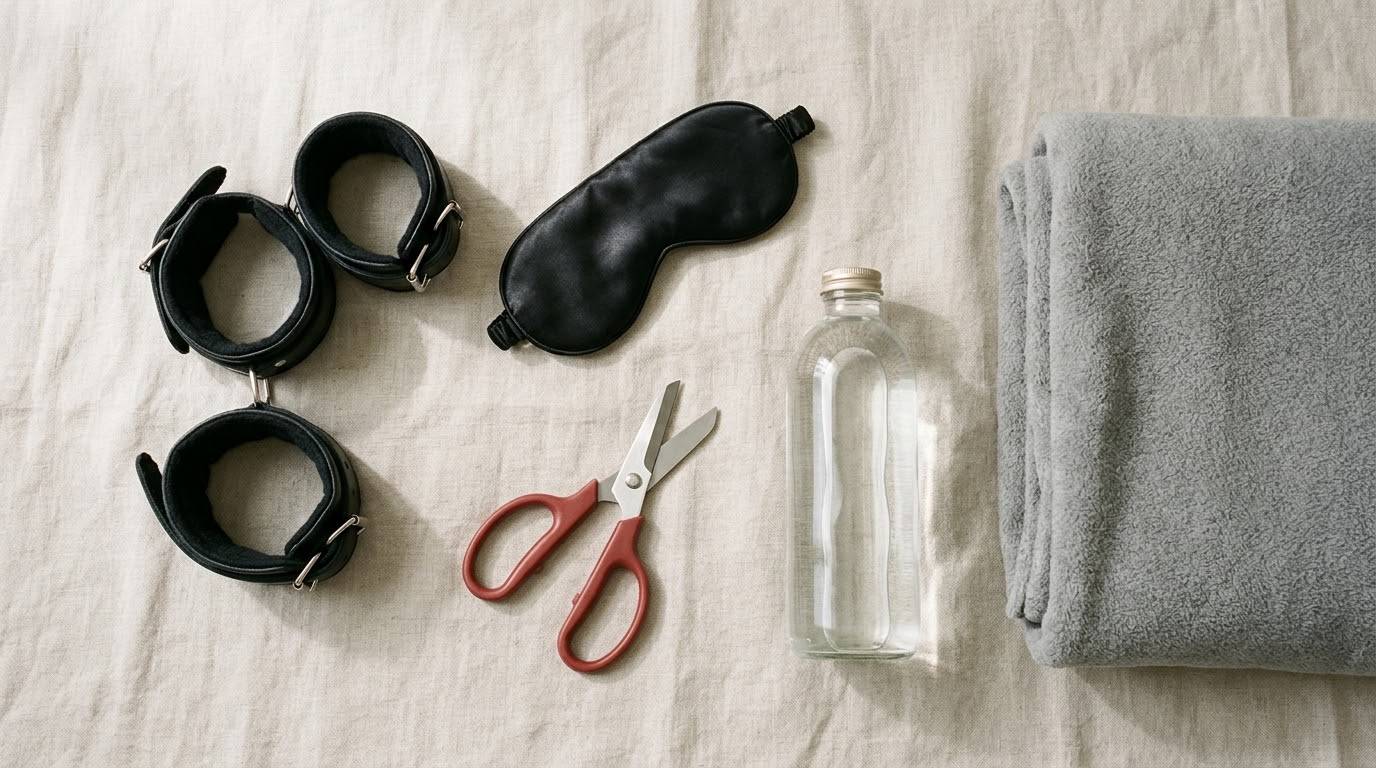
- Keep safety basics within reach. Have safety shears beside any restraint, never leave a restrained person alone, keep anything away from the neck, and avoid breath play entirely. Check hands and feet regularly for numbness, tingling or colour change.
- Check in during the scene. A quick colour check or a simple question keeps both partners connected. Consent given at the start can be withdrawn at any moment, and a safeword is always honoured immediately.
- Give aftercare. After a scene, slow down together: water, a blanket, physical closeness, reassurance and talk. Aftercare helps both partners come down from the adrenaline and emotion of play.
- Debrief the next day. Talk about what worked, what did not and what you would change. Feelings sometimes surface a day or two later, so a short follow-up conversation is part of good practice.
The traffic-light system: green — all good, carry on; yellow — slow down or check in; red — stop everything now. Simple enough to remember in any state, and easy for either partner to call.
08Safety essentials
Most BDSM injuries are avoidable, and the basics are simple.
- Safety shears next to any restraint. Rope, cuffs and ties should be removable in seconds, whatever happens.
- Never leave a restrained person alone, not even for a moment.
- Nothing around the neck, and no breath play. Restricting breathing or blood flow to the head can cause loss of consciousness and death within moments, with no reliable warning. It has no safe beginner version.
- Mind the nerves. Nerve compression is the most common rope injury. A 2023 study of injuries from Japanese rope bondage found the radial nerve in the upper arm was affected in nine of ten people, mostly after suspension, with recovery taking from minutes to months.8 Avoid tying over the upper arm and joints, and check hands and feet regularly for numbness, tingling, coldness or colour change.
- Impact play on muscle, never on bone or organs. Buttocks and thighs are the classic targets; the spine, kidneys, joints, neck and head are off limits.
- Learn advanced skills from people who teach them. Suspension and complex rope work need hands-on instruction, not a video.
- Stay sober enough to judge. Alcohol and drugs blunt both the ability to consent and the pain signals that keep play safe.
09Aftercare and drop
Aftercare is the time partners spend looking after each other when a scene ends. Intense play floods the body with adrenaline and strong emotions; coming down from that matters as much as the scene itself.
What aftercare looks like varies: water and a snack, a blanket, holding each other, quiet talk, reassurance that the scene was wanted and enjoyed. It is for both partners, not only the submissive. Some people feel a dip in mood hours or even days later, often called sub drop or top drop. It is common, usually passes, and is easier when partners check in with each other the following day.
10Kink is not abuse
BDSM and abuse can involve similar actions. What separates them is everything around the actions.
BDSM
- Negotiated in advance
- Limits set by both partners
- Safeword honoured instantly
- Consent can be withdrawn any time
- Aftercare and care outside scenes
Abuse
- Pressure, guilt or fear
- Limits ignored or mocked
- “Stop” does not stop it
- Refusal is punished
- Control spills into daily life
If anything in the right-hand column sounds familiar, it is not kink, whatever it is called. Talk to someone you trust or to a local domestic abuse service.
11BDSM in photography and art
Few kinks have a stronger visual tradition. Leather and latex fashion, the geometry of Japanese rope work, the theatre of power in staged portraits: BDSM imagery has influenced fashion, music videos and fine-art photography for decades. Done well, it is about texture, tension, trust and composition rather than shock.
- Light for texture. Low, hard side light brings out leather, latex and rope; soft light flatters skin. Many of the best images combine the two.
- Show the trust. An expression, a hand resting on a shoulder, the moment before or after: the human connection is what lifts BDSM imagery above the generic.
- Shoot the details. Knots, buckles, the pattern of rope on skin, a gloved hand. Close-ups often say more than wide shots.
- Keep safety off camera, not out of the room. Shears, water and a spotter belong on set, especially for rope work.

Creating BDSM content for BentBox? Everyone in the content must be a verified adult with a release form, and the content must be consensual and clearly read as consensual. Public cover images must be glamour or artistic, with explicit material kept inside the Box. Check the forbidden content rules before you upload.
Curiosity, good taste and no taboos
BentBox is a marketplace for independent creators, photographers and collectors who believe desire deserves to be shown with care, craft and honesty. Every creator is verified, and every piece of content is consensual.
Join BentBox For collectors →FAQFrequently asked questions
What does BDSM stand for?
BDSM is an umbrella term built from three overlapping pairs: bondage and discipline, dominance and submission, and sadism and masochism. It covers consensual activities involving restraint, power exchange, role-play and intense sensation. Not all BDSM involves pain, and not all of it is sexual.
How common is BDSM?
Far more common than most people think. In a nationally representative US survey, about 21 percent of women and 22 percent of men had tied up a partner or been tied up during sex, and around a third had spanked or been spanked. Fantasies are even more widespread: in a survey of more than 4,000 Americans, 93 percent of women and 81 percent of men had fantasised about being sexually dominated.
Is BDSM a mental illness?
No. The World Health Organization's ICD-11 removed consensual sadomasochism and fetishism as diagnoses, on the basis that consensual BDSM is not linked to poor psychological or social functioning. The disorder that remains, coercive sexual sadism disorder, specifically excludes consensual activity and concerns non-consenting people. A Dutch study of 902 BDSM practitioners found they were, on average, less neurotic and reported higher wellbeing than a control group.
Is Fifty Shades of Grey an accurate picture of BDSM?
Only partly. The series brought BDSM into the mainstream and sold over 100 million copies, but many practitioners criticise its portrayal of consent, and a 2013 academic analysis found patterns of intimate partner violence in the central relationship, including stalking, intimidation and isolation. Real BDSM is built on negotiation, freely withdrawable consent, safewords and aftercare.
What is the difference between BDSM and abuse?
Consent. BDSM is negotiated in advance, agreed by adults who can say no, limited by boundaries both partners set, and stoppable at any moment with a safeword. Abuse ignores limits, uses pressure or fear, punishes refusal and continues after someone says stop. A submissive partner in BDSM holds real power, because the scene only goes as far as they allow.
What is a safeword?
A safeword is a pre-agreed word that stops or slows the activity immediately, chosen because it would not come up naturally in a scene. Many people use the traffic-light system: green to continue, yellow to slow down or check in, red to stop completely. A non-verbal signal, such as dropping a held object, is used whenever speaking might be difficult.
What is aftercare in BDSM?
Aftercare is the time spent caring for each other after a scene: water, warmth, physical closeness, reassurance and conversation. Intense play releases adrenaline and strong emotions, and some people experience a low mood, often called sub drop or top drop, hours or days afterwards. Aftercare and a follow-up conversation help both partners come down safely.
How do I start exploring BDSM with a partner?
Start with a conversation outside the bedroom, make a yes, no and maybe list together, and agree a safeword before trying anything. Begin with light activities such as blindfolds, soft cuffs or light spanking, check in during the scene, give aftercare afterwards and debrief the next day. Build intensity gradually, over many sessions.
Is rope bondage dangerous?
It carries real risks if done without knowledge. Nerve compression is the most common injury: a 2023 study of rope bondage injuries found the radial nerve in the upper arm was affected in most cases, mainly after suspension. Avoid tying over the upper arm and joints, keep safety shears within reach, check hands for numbness or tingling, never leave a tied person alone, and learn from experienced teachers before attempting anything advanced, especially suspension.
Can BDSM content be sold on BentBox?
Yes, when it is consensual, everyone in it is a verified adult with a release form, and it complies with BentBox's content rules. Public cover images must be glamour or artistic, with explicit material kept inside the Box. Content must clearly read as consensual, and creators should check the forbidden content rules before uploading.
SOURCESReferences
- Bertelsmann. Fifty Shades: 100 Million Books Sold. Bertelsmann, 2014.
- Amy E. Bonomi, Lauren E. Altenburger and Nicole L. Walton. "Double Crap!" Abuse and Harmed Identity in Fifty Shades of Grey. Journal of Women's Health, 2013.
- Debby Herbenick et al.. Sexual diversity in the United States: Results from a nationally representative probability sample of adult women and men. PLOS ONE, 2017.
- Justin J. Lehmiller. 3 Sex Fantasies That Are More Common Than You Think. Sex and Psychology.
- Christian C. Joyal, Amélie Cossette and Vanessa Lapierre. What Exactly Is an Unusual Sexual Fantasy?. The Journal of Sexual Medicine, 2015.
- Andreas A. J. Wismeijer and Marcel A. L. M. van Assen. Psychological Characteristics of BDSM Practitioners. The Journal of Sexual Medicine, 2013.
- Richard B. Krueger, Geoffrey M. Reed et al.. Proposals for Paraphilic Disorders in the International Classification of Diseases and Related Health Problems, Eleventh Revision (ICD-11). Archives of Sexual Behavior, 2017.
- Vladimir Khodulev et al.. Acute Radial Compressive Neuropathy: The Most Common Injury Induced by Japanese Rope Bondage. Cureus, 2023.
This article is for general education about sexuality and is not medical or psychological advice. If you are worried about your safety in a relationship, please contact a local support service.