
What Is Pornography?
Everyone thinks they know it when they see it. Here is what the word actually means, where it came from, and how lawmakers, regulators and platforms draw the line today.
Pornography is material, whether images, video, text or audio, made mainly to cause sexual arousal, usually by showing sexual activity or the genitals explicitly. The definition sounds simple. Ask ten people where the line falls between a nude and a pornographic image, though, and the answers start to drift. A US Supreme Court justice admitted as much in 1964, and lawmakers have been trying to do better ever since.
This piece is a map rather than a verdict. It looks at where the word came from, how its meaning changed, how lawmakers and platforms define it today, and what it is not.
| Origin of the word | Greek pornē (prostitute) + graphein (to write or draw) |
|---|---|
| First use | 1769: Restif de la Bretonne, Le Pornographe, a treatise on regulating prostitution |
| Modern meaning | From the mid-19th century: obscene images and texts made to excite |
| Naples Secret Museum | Erotic finds from Pompeii locked away from 1821; fully open to the public from 2000 |
| "I know it when I see it" | Justice Potter Stewart, Jacobellis v. Ohio (1964) |
| US obscenity test | Miller v. California (1973), three-part test |
| UK legal definition | Online Safety Act 2023, s.236: produced solely or principally for sexual arousal |
| UK age checks mandatory | 25 July 2025, for services publishing pornographic content |
| EU | No single definition; the Audiovisual Media Services Directive requires protecting minors |
01 · The word
Where does the word pornography come from?
The roots are ancient Greek, but the word is not. The Greeks had pornē and they had graphein, yet nobody in Athens wrote about "pornography". The word was put together in eighteenth-century France, and it meant something quite different from what it means now.
-
AntiquityTwo Greek words Pornē, a prostitute, and graphein, to write or draw. The Greeks had both words, but never put them together in our sense.
-
1769Le Pornographe Restif de la Bretonne coins the term for a writer on prostitution. His book is a proposal to regulate sex work, not an erotic text.
-
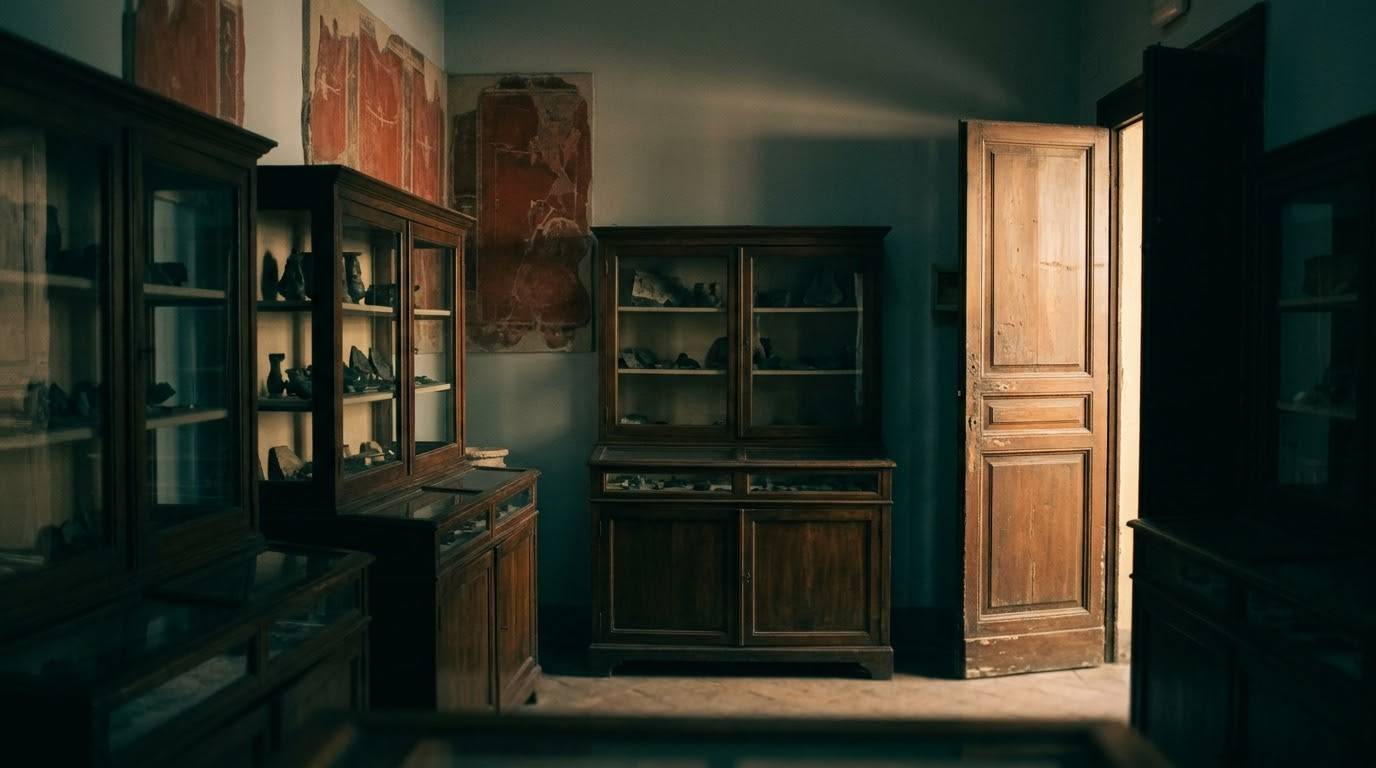
1821The Secret Museum Erotic finds from Pompeii are locked away in a restricted room in Naples. Scholars need a reason, and often Latin, to get in. It does not open fully to the public until 2000.
-
Mid-1800sThe meaning shifts The word drifts from "writing about prostitutes" to any image or text considered obscene and made to excite.
-
1964"I know it when I see it" US Justice Potter Stewart admits hard-core pornography resists definition, and coins the most quoted line on the subject.
-
2023A definition in statute The UK Online Safety Act defines pornographic content by its likely purpose: produced solely or principally for sexual arousal.
This is the story of the word. For the story of the images themselves, from Roman frescoes to creator platforms, read A Short History of Pornography.
Restif de la Bretonne's Le Pornographe (1769) was a reform proposal: a plan for regulating prostitution to protect the women involved and public health. "Pornographer", for him, meant a writer who studies prostitutes, the way a geographer studies the earth.
The modern meaning grew up around a problem of display. When excavations at Pompeii uncovered frescoes, sculptures and everyday objects with frank sexual imagery, the authorities in Naples did not know what to do with them. In 1821 they locked them in a restricted cabinet, open only to "mature" visitors with a respectable reason to look. The doorway was even bricked up for a time, and the collection did not open fully to the general public until 2000. The historian Walter Kendrick argued that the modern idea of pornography was born in rooms like that one: it began as a category of things that some people could see and others could not.
02 · The definition
How is pornography defined?
In 1964 the US Supreme Court heard Jacobellis v. Ohio, a case about a French film an Ohio cinema manager had been convicted for showing. Justice Potter Stewart wrote that he would not try to define hard-core pornography any further, and then added the sentence he is remembered for.
I know it when I see it.Justice Potter Stewart, concurring, Jacobellis v. Ohio, 378 U.S. 184 (1964)
Stewart meant it as an admission, and that is why the line lasts. Pornography is one of those categories everyone recognises and nobody can quite fence in. In practice, different institutions answer the question through five different lenses.
The dictionary
Material that depicts sexual activity or the sexual organs explicitly, intended to stimulate sexual excitement. Two ingredients: explicitness and purpose.
The law
Depends on where you stand. The UK defines it by purpose, the US regulates obscenity rather than pornography, and the EU has no single definition.
Regulators
Ofcom judges the content itself in context, not the label it carries or what any one viewer feels about it.
Platforms and payments
Social networks, app stores and card networks each set their own rules. They classify what is actually shown and sold.
Philosophy
Critics and scholars ask what pornography does, not only what it shows: to the viewer, to the people depicted, to the culture around it.
03 · The law
What is the legal definition of pornography?
Legal systems disagree not only on where the line is, but on which line to draw in the first place.
Defined by purpose
The Online Safety Act 2023, s.236, treats content as pornographic when it is reasonable to assume it was made solely or principally for sexual arousal. Since 25 July 2025, services publishing it must use highly effective age checks.
Obscenity, not pornography
Adult pornography is protected speech. What the law targets is obscenity, judged by the three-part Miller v. California test (1973), including whether the work has serious artistic, literary, political or scientific value. Several states now require age verification.
No single definition
The Audiovisual Media Services Directive requires that minors be protected from pornography but does not define the word. Member states set their own rules, so the answer in Paris may differ from the answer in Amsterdam.
The UK approach is worth a closer look, because it is the most explicit attempt to write the dictionary definition into law. The regulator, Ofcom, says it judges the content itself and its context. A caption calling something "art" does not change what the image shows, and one viewer finding something arousing does not make it pornography either.
04 · The test
How can you tell if something is pornographic?
Strip the definitions down and nearly all of them ask two things. How explicit is it? And what is it for? Put those on two axes and the territory sorts itself out.
Suggestive
Glamour, boudoir, erotica. Plays with desire, shows little.
Pornography
Explicit, and arousal is the point.
Art and document
Fine-art nudes, naturist and documentary photography.
Clinical
Medical, anatomical and sex-education material. Explicit, not erotic.
The borders are blurry by design. One shoot can produce images in three of the four squares.
The top-right square is pornography. The others can contain nudity, sexuality or both, and still be something else. The boundary between "suggestive" and "pornographic" is where most arguments happen. We look at it in detail in Glamour, Boudoir, Erotic Art and Pornography, including why an open-leg pose usually crosses it even when nothing else is happening in the frame.
05 · The exceptions
Is nudity pornography?
Ofcom's guidance is useful here because it lists examples of content that shows nudity or deals with sex but is not, on its own, pornographic. Among them:
- Glamour and boudoirSuggestive imagery whose main purpose falls short of sexual arousal.
- Fine-art and documentary nudityThe body as form, or as a fact of the scene: a life study, a naturist beach, a changing room.
- Education and medicineAnatomy, sex education and clinical imagery, however explicit.
- Drama and comedyNudity or sex that serves the story or the joke rather than being the point.
- JournalismNon-sexual nudity in reporting and news imagery.
The common thread is that the body is present, sometimes completely, but arousal is not the reason the material exists. That is the distinction photographers have defended since the first nude studies, and the one social networks most often fail to make when they treat every nipple as a violation.
06 · The ideas
What have critics and scholars said about pornography?
Beyond the law, pornography has been one of the most argued-over subjects in modern criticism. Four positions are worth knowing, and they disagree sharply with one another.
Susan Sontag
The Pornographic ImaginationArgued that some pornographic writing could be serious literature, exploring the extremes of human consciousness, and should be read as such.
Andrea Dworkin & Catharine MacKinnon
The civil-rights ordinanceDefined pornography not by explicitness but as sexually explicit material that subordinates women, and proposed letting those harmed sue.
The anti-censorship feminists
Feminist Anti-Censorship TaskforcePushed back: censorship would hurt women and sexual minorities more than it protected them, and sexual expression deserved defending.
Linda Williams
Hard CoreStudied pornographic film as a genre, with its own history and conventions, driven by a drive to make pleasure visible on screen.
For a more philosophical angle, the Italian actor and director Carmelo Bene placed the pornographic at the moment the person disappears and only the body remains. We discuss his idea in our glamour article.
07 · In practice
How does BentBox draw the line?
BentBox allows adult content, and we think the honest thing is to be precise about what that means rather than vague. We separate what anyone can see from what a buyer chooses to open.
Covers and pages
Everything visible before a purchase stays on the glamour and artistic side: no genital close-ups, no sexual acts, no bodily fluids.
Adults, by choice
Explicit content is allowed inside a Box, for verified buyers who choose to open it, only when it is consensual and covered by a signed release form.
Whichever side of the line a piece sits on, the rules underneath are the same. Every creator is identity verified, every person depicted must be a consenting adult, and sexual content must carry a release form. Card networks require this for adult content, and we would require it anyway.
Frequently asked questions
Keep reading
How did we get from Pompeii to the phone in your pocket? Read A Short History of Pornography. Where exactly does glamour end and pornography begin? See Glamour, Boudoir, Erotic Art and Pornography: Where the Lines Are. For the craft side of the debate, see The Model Is Not the Subject.Sources
- Online Safety Act 2023, section 236 (definition of pornographic content)
- Ofcom: what to do if your online service allows pornography
- Jacobellis v. Ohio, 378 U.S. 184 (1964)
- Miller v. California, 413 U.S. 15 (1973)
- Audiovisual Media Services Directive, Directive (EU) 2018/1808
- Secret Museum, Naples (Wikipedia)
- Dictionnaire de l'Académie française: pornographe
- Bad Books: Rétif de la Bretonne, Sexuality, and Pornography (Rutgers University Press)
- Walter Kendrick, The Secret Museum: Pornography in Modern Culture (1987)
- Susan Sontag, "The Pornographic Imagination", Partisan Review (1967)
- Linda Williams, Hard Core: Power, Pleasure, and the "Frenzy of the Visible" (1989)
This article is general information, not legal advice. Rules on adult content differ by country and by platform and change often.