
The Model Is Not the Subject
Why four hundred frames of a person against a backdrop is not a photograph, and what is.
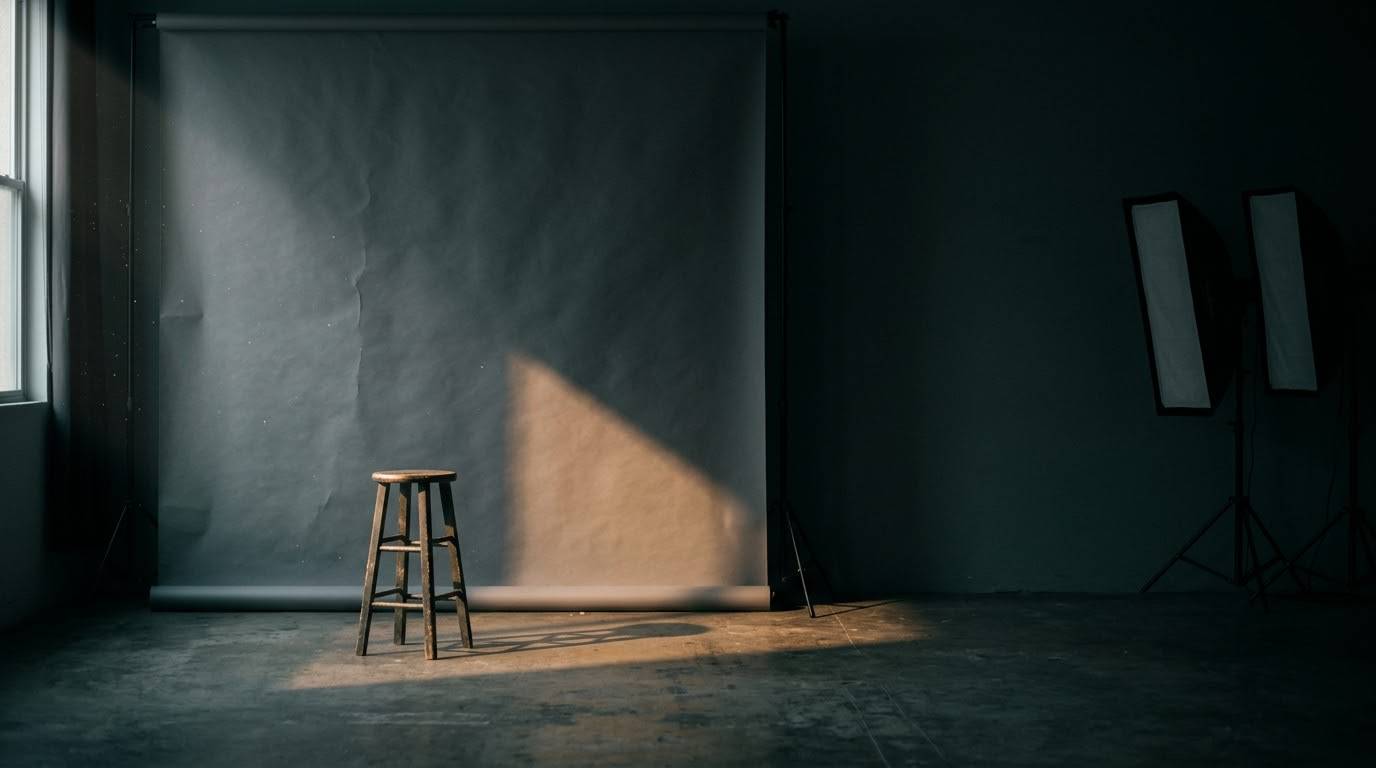
You have seen the set. You may have shot it. A rented studio, a grey paper backdrop, two softboxes at forty-five degrees, a model who arrived on time and did exactly what was asked. Three hours later there are four hundred frames on the card, and by the end of the week two hundred of them are online in a single gallery, in the order they were taken. She stands. She turns. She sits on a stool. The shirt comes off. The stool again. Same light, same distance, same expression, frame after frame after frame.
I want to be careful here, because I have done this myself, more than once, and I enjoyed every minute of it. There is nothing shameful about a pleasant afternoon with a camera and a willing collaborator, and there is nothing wrong with the people who enjoy looking at the result. But let us call it what it is. That gallery is not a body of photographic work. It is a record of access. Its value, the only value it has, is that you were in the room and now the viewer gets to be in the room too.
That is voyeurism. Gentle, consensual, often affectionate voyeurism, but voyeurism. And voyeurism is not photography. It just happens to use a camera.
Clicking is not photographing
Everyone owns a camera now. The act of pointing one at something and pressing a button has never been cheaper or easier. When I say photography in this piece, I do not mean that act. I mean the art: the discipline of making an image that carries something it would not carry if someone else had made it.
The mistake at the heart of the model set is a confusion about the subject. The photographer believes the subject is the model. She is beautiful, she is undressed, she is there, so surely she is the point. She is not. She is an element of the picture, in the same way the light is, the shadow is, the crease in the sheet is, the empty space on the left of the frame is. An important element, often the most important one. But an element.
Here is a simple test I use on my own work. Imagine the same image with a different model: same light, same pose, same framing. Does the picture survive? If its value collapses the moment you swap the person, then the value was never in the picture. It was in the person, and you were a very well-equipped witness. If the picture still holds, if it still has a mood, a tension, a question, then you made something.
So where does the value come from?
From the eye behind the camera. From the fact that someone looked at a situation and decided what it meant, and then used every tool available to make the viewer feel that meaning too. Intent is the whole game. Without it you have documentation; with it you have an image.
And the tools are not mysterious. They are the same tools every photographer has, used deliberately instead of by default:
- Light is not illumination, it is opinion. Two softboxes at forty-five degrees say nothing at all, which is exactly why they are the default. A single hard source from behind says something. A window at dusk says something else.
- Shadow is what you choose not to show, and what you do not show is often where the image lives. The amateur set lights everything because it is afraid of losing anything. The photograph decides what to lose.
- Texture: the wrinkles in linen, the grain of old wood, the fine lines at the corner of an eye, the goosebumps on a cold arm. These are the details that make a picture feel lived in rather than staged.
- Expression and gesture: not a smile on command, but a half-second of distraction, a hand that does not know where to rest, a look away from the lens that tells you she is thinking about something you will never know.
- Space and composition: where the figure sits in the frame, how much emptiness surrounds it, what the edges cut. A body placed small in a large dark room is a different sentence from the same body filling the frame.
None of these require expensive gear. All of them require a decision.
Poses are borrowed words
Watch most amateur shoots and you will see the same dozen poses: hand on hip, hand in hair, look over the shoulder, arch the back. They are not wrong. They are just not yours. They are the photographic equivalent of greeting-card phrases, borrowed vocabulary that fills the space where a thought should be.
The alternative is not to invent exotic contortions. It is to stop directing positions and start directing feelings. Do not tell a model to put her hand on her neck. Tell her she has just received news she has not decided how to feel about. Then shut up and watch. The pose that comes out of that is one nobody has seen before, because it belongs to that moment and that person and that idea.
Choosing is the art
If there is one habit that separates photographers from people with cameras, it is editing. Not retouching. Choosing.
Uploading two hundred frames from one session is a refusal to choose. It hands the hardest part of the work to the viewer and says: you find the good one. Most of the time there is no good one, because no single frame was ever meant to stand on its own. But when there is, it drowns in the hundred and ninety-nine around it.
Out of four hundred frames, you might have one image. On a very good day, three. Show those. Throw the rest away, or at least keep them where nobody else has to look at them. An image that has been chosen tells the viewer that someone cared enough to decide. A gallery of everything tells them nobody did.
Before your next shoot
Write one sentence. Not a mood board, not a shot list. One sentence about what the picture is about, and it is not allowed to contain the word "model" or the model's name. "Waiting for someone who is not coming." "The last warm hour of the year." "A body as a landscape." Then design the light, the space, the clothing or the lack of it, the direction, all in service of that sentence.
Shoot less. Look longer between frames. When it is over, choose ruthlessly. Show only what you would be willing to hang on a wall with your name under it.
The camera clicks for everyone. That has never been the hard part. The hard part is having something to say, and the discipline to say only that.