
What noir actually is
Noir is French for black. After the Second World War, French critics began calling a run of dark American crime films film noir: stories of detectives, double-crosses and doomed lovers, shot mostly at night, in rain-wet streets and rooms where the only light came through a window blind.
The look didn't come from nowhere. Its roots run through German Expressionist cinema, the hard-boiled crime novel and, just as much, through still photography. In Paris, Brassaï was photographing the city after dark at the start of the 1930s. In New York, Weegee was chasing crime scenes at night with a flashgun; his 1945 book Naked City gave its title to the 1948 film The Naked City.
So when we talk about noir photography today, we mean pictures that share that cinema's look and its state of mind: low-key light, deep shadow, a sense that something has just happened or is about to.
The light: low-key, hard, deliberate
Noir is first of all a way of lighting. Standard portrait lighting uses three lights: a key light, a fill light to soften the shadows, and a back light to separate the subject from the background. Noir throws most of that away.
The technical name is low-key lighting: usually a single key light, with little or no fill. What matters is the lighting ratio, the difference in strength between the lit and the shadow side. Bright, even, high-key light gets close to 1:1. Low-key work sits around 8:1 or higher, which is why half a face can simply vanish.
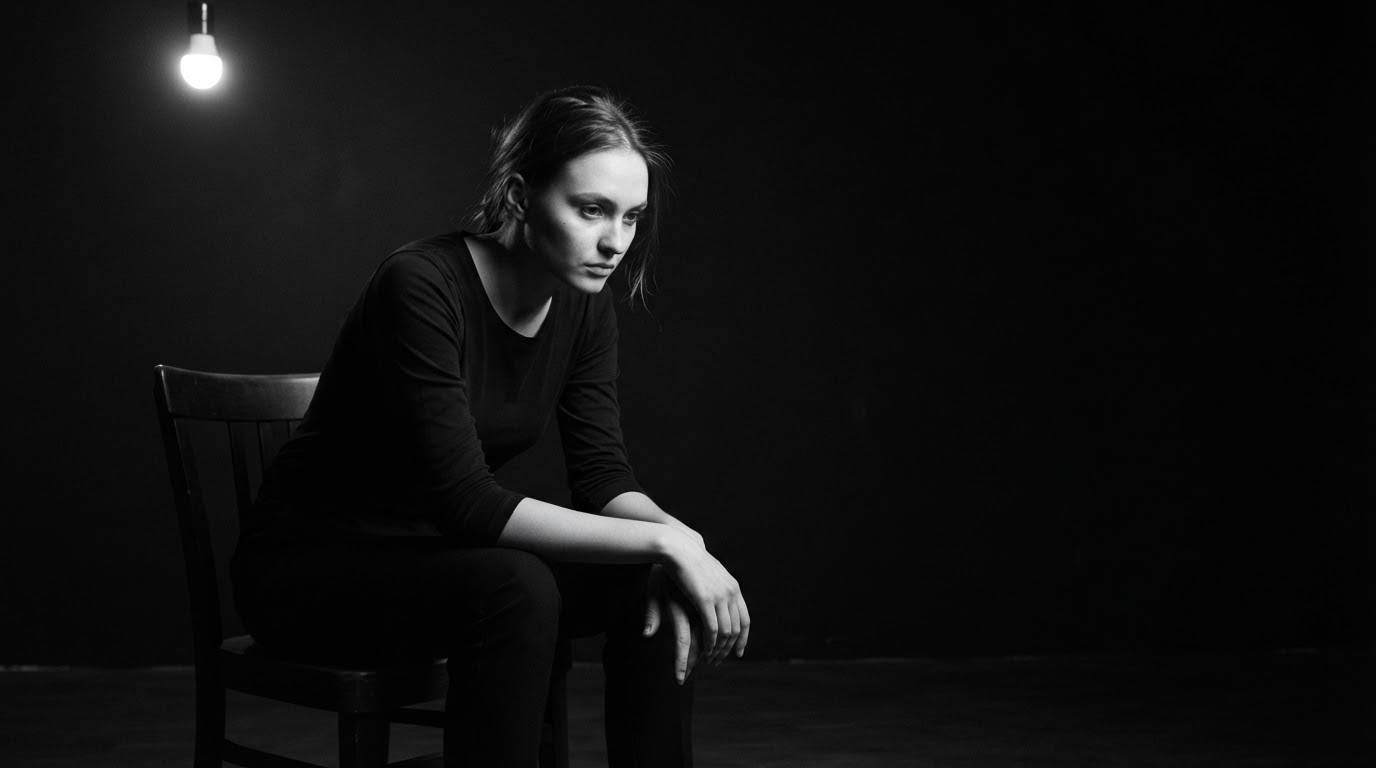
A few elements come back again and again:
One hard source
A bare bulb, a spotlight, a street lamp, a slice of sun. Hard light gives crisp shadow edges; soft light blurs them away.
Shadow patterns
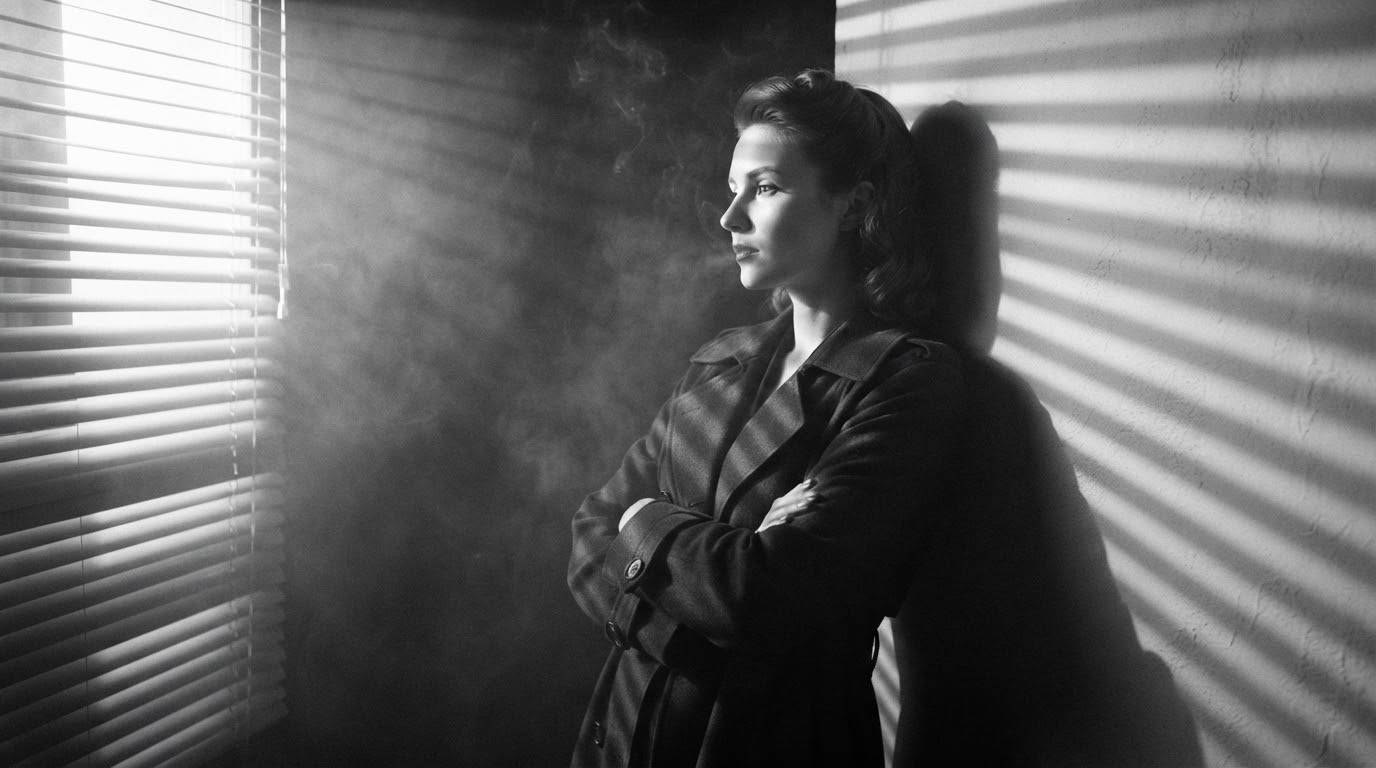
Venetian blinds, window frames, banisters, leaves. The shadow becomes part of the composition, often cutting across the subject.
Atmosphere
Smoke, haze, fog, steam or a wet street. They catch the light and make the beam itself visible.
Real blacks
Large areas of the frame are allowed to go completely black. Nothing is lifted to show detail that the story doesn't need.
The cinematographer most associated with this look, John Alton, wrote the book on it, literally. His Painting with Light (1949) is still taught in film schools, and his position was simple: the most beautiful photography is in a low key with rich blacks. The point of the light, for Alton, was never just to illuminate; it was to create mood.
The mood: what you don't show
Technique alone doesn't make a picture noir. A dark photograph of a smiling model is just a dark photograph. Noir is about tension and ambiguity: the picture suggests a situation and leaves the viewer to fill in the rest.
- A moment, not a pose. Someone waiting by a door, reading a letter, looking over a shoulder. Something is going on outside the frame.
- The gaze looks away. Eye contact with the lens is rare. The subject is in the scene, not presenting to the camera.
- Concealment. A face half in shadow, a figure seen through a doorway, a silhouette against a window. What is hidden is as important as what is lit.
- Place matters. Hotel rooms, stairwells, empty bars, cars at night, rain. The setting is a character in its own right.
Film noir also gave us its archetypes, the femme fatale above all: a woman who is in control, unknowable and possibly dangerous. That idea runs through a lot of noir figure and fashion photography. It's worth noticing what it changes: the model is not there to be looked at, she is there to be wondered about.
Glamour asks: how beautiful is she? Noir asks: what just happened here?
Noir vs glamour: what changes
Noir and glamour grew up side by side in the same Hollywood studios, and they share more than you'd think. George Hurrell, the portraitist credited with inventing the Hollywood glamour portrait, used spotlights and shadow too. The difference is not simply dark versus bright; it's what the light is for.
Glamour light is there to idealise the subject. Hurrell's portraits were heavily retouched, lit to sculpt cheekbones and perfect skin, and designed to make a star look superhuman. Noir light is there to build a scene, and the subject is one part of it.
| Glamour | Noir | |
|---|---|---|
| Purpose | Flatter and idealise the subject | Create mood and suggest a story |
| Light | Controlled, often soft, carefully filled | Hard, single source, little or no fill |
| Shadows | Shaped to sculpt the face and body | Large, deep, allowed to swallow detail |
| Gaze | Often straight to the lens | Usually averted, or the face is hidden |
| Setting | Clean backdrop or styled set | Real-feeling places: rooms, streets, night |
| Finish | Polished, retouched, flawless | Grain, contrast and imperfection accepted |
| The viewer | Admires | Wonders |
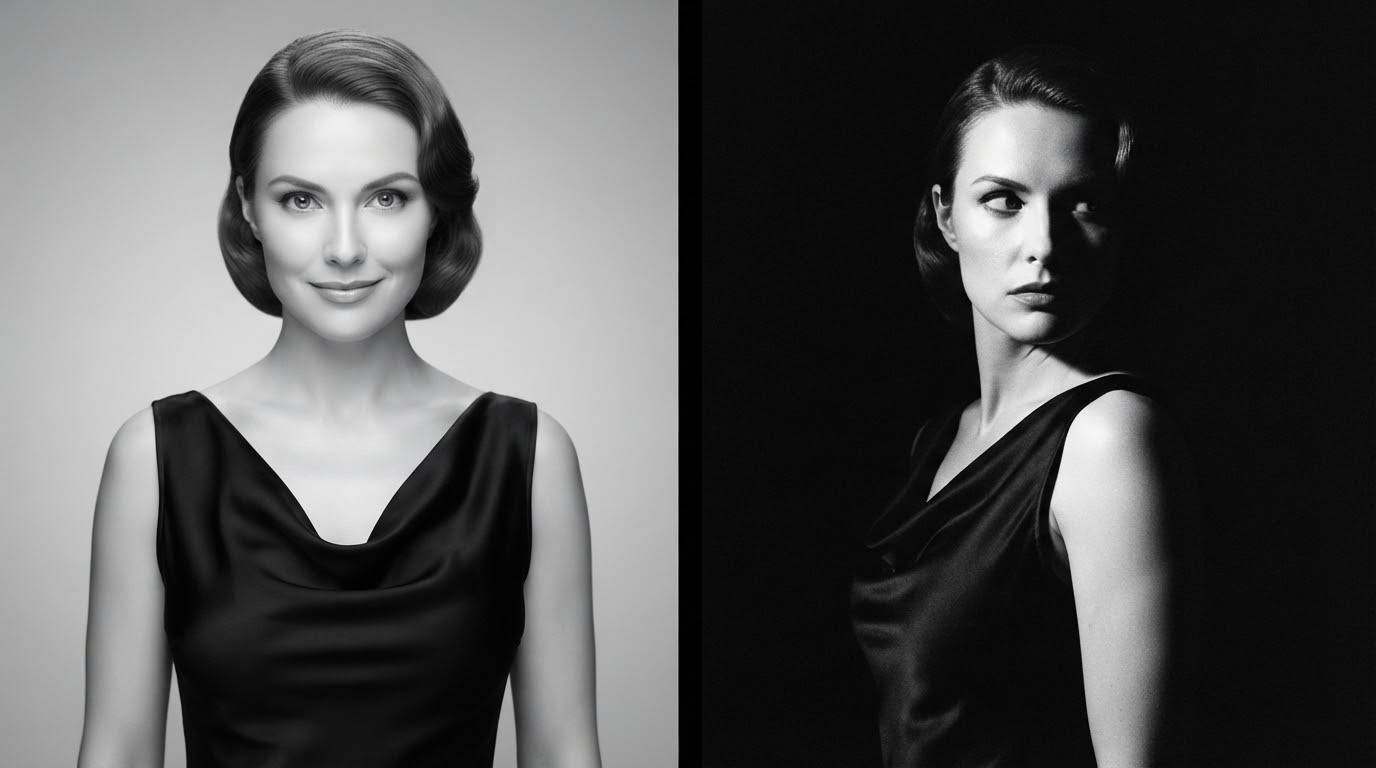
History even tilted from one to the other. When Hurrell returned to Hollywood in the 1950s, his polished style of glamour had gone out of favour, replaced by an earthier, grittier look. You can see both worlds this winter: the Smithsonian's National Portrait Gallery in Washington is showing Star Power: Photographs from Hollywood's Golden Age by George Hurrell until 10 January 2027.
In practice, plenty of the best work sits between the two: glamour styling and wardrobe, photographed with noir light. That's essentially the territory Helmut Newton made his own.
Photographers to study
None of these photographers set out to make "noir photography". Each, in a different way, helped define what the word means visually. Look them up in museum collections and photobooks rather than on random image boards, where prints are often cropped or badly reproduced.
Brassaï Paris, 1930s
A Hungarian-born journalist who walked Paris at night with a camera and tripod. His book Paris de nuit, published in the winter of 1932–33, surveyed the city after dark, from the bars of Montparnasse to fog-bound streets and bridges over the Seine. Study him for atmosphere: fog, gas lamps, wet cobblestones, and light used sparingly.
Weegee New York, 1930s–40s
Arthur Fellig, known as Weegee, was a freelance press photographer who followed the police radio around New York at night. His flash-lit pictures of crime scenes, crowds and nightlife have the air of film stills, and Naked City (1945) was bought by Hollywood for the film of the same name. Study him for direct flash at night and for the drama of the bystander.
Bill Brandt London, 1945–61
Brandt's series of nudes, collected in Perspective of Nudes (1961), placed models in dark, nearly empty interiors and printed them with deep blacks and stark whites. He pushed tonal contrast in the darkroom and used distorted perspective to make the body strange. Study him if you shoot nudes and figure work: he is the clearest proof that noir and the nude belong together.
Helmut Newton Fashion and nudes, 1960s–2000s
Newton's admiration for film noir and Hitchcock runs through his work: black and white film, powerful women, and sequences that feel like scenes from a thriller you haven't seen. He moved freely between fashion, portrait and nude. Study him for narrative, and for how a glamorous model can be lit and directed as a noir character.
Daido Moriyama Japan, 1960s onwards
With the Provoke group in the late 1960s, Moriyama championed are, bure, boke: grainy, blurry, out of focus. His high-contrast street pictures are not noir in the Hollywood sense, but they push its spirit to the edge. Study him for grain, contrast and imperfection as expressive tools rather than flaws.
John Alton Cinematographer, 1940s–50s
Not a stills photographer, but the most useful single reference for noir light. Read Painting with Light and watch the films he shot, such as T-Men (1947), Raw Deal (1948) and The Big Combo (1955). Study him for how little light you actually need.
Films to watch with a camera in mind
Noir photography borrows so much from cinema that a few evenings of film are the best homework there is. Pause often. Look at where the light comes from, what is left in shadow, and where the actors are looking.
- Double Indemnity (1944): venetian-blind shadows and the template femme fatale.
- The Naked City (1948): the film named after Weegee's book, shot on the streets of New York.
- The Third Man (1949): tilted angles, wet streets and one of cinema's great reveals in a doorway.
- The Big Combo (1955): John Alton at his most extreme, figures in fog lit by almost nothing.
- Touch of Evil (1958): late classic noir, all night, neon and deep shadow.
- Blade Runner (1982): neo-noir in colour, with smoke, rain and blinds carried into the future.
How to shoot noir with one light
The good news: noir is one of the cheapest styles to shoot well. It rewards discipline more than equipment.
- Start in the dark. Switch off every light in the room and block out daylight, so the only light in the picture is the one you add.
- Use one hard light. Place a single hard source, such as a bare flash, a small LED or a lamp, to the side of or above the subject, and leave the fill light off.
- Shape the shadows. Put a blind, a window frame, plants or a cut-out card between the light and the subject to throw a pattern across the scene.
- Expose for the highlights. Meter for the lit side of the face or body and let the rest fall into black. Do not lift the shadows to rescue detail.
- Direct a moment, not a pose. Give the model a situation: waiting, listening, about to leave. Averted eyes and a half-hidden face suggest a story better than a smile at the lens.
- Finish in black and white. Convert to black and white, keep the blacks deep and the highlights clean, and accept grain as part of the look.
For the model, noir is closer to acting than posing. Talk through the scene before you start: who she is waiting for, what's in the letter, why she is leaving. Small, held moments read better than big gestures. A cigarette, a glass, a telephone or a hat are classic props because they give the hands and eyes something to do.
Noir in colour
Classic noir is black and white because the films were. Neo-noir, from the 1970s on, kept the low-key light and the mood but added colour. If you shoot in colour, keep the palette narrow: one or two hues, such as a neon red against teal shadows or a single warm practical lamp in a cold room, and let the rest go dark. The rules of the light stay the same.
Where noir work fits on BentBox
If you shoot noir figure or glamour work and sell it on BentBox, the style has a practical advantage. Public Box covers must be glamour or artistic, nothing explicit, and noir works precisely by concealing. A half-lit body or a silhouette against a window makes a strong cover; the rest of the set lives inside the Box.
A noir set also works well as a sequence rather than a pile of similar frames: arrival, waiting, the moment, the aftermath. Thirty to fifty images edited like a short film will say more than three hundred variations of the same pose. There is more on that in Less is more.
For single images that aren't for sale, the Art Wall is a curated wall of artistic and glamour photography. It favours work shot with staged, deliberate lighting, which is exactly what noir is.
Sources
- Low-key lighting, Wikipedia
- John Alton: Master of the Film Noir Mood, American Cinematographer
- Painting with Light by John Alton, University of California Press
- Brassaï, La Colonne Morris dans le Brouillard, The Metropolitan Museum of Art
- Weegee, Encyclopaedia Britannica
- How Tabloids Inspired Film Noir, TIME / LIFE Books
- Bill Brandt: working methods, Victoria and Albert Museum
- Helmut Newton, International Center of Photography
- The Ultimate Guide to Are, Bure, Boke, The Photographers' Gallery
- George Hurrell, International Center of Photography
- The Photographer Who Captured the Glamor of Hollywood's Golden Age, PetaPixel