
Four hundred frames, nothing said
There is a kind of photo session every photographer has seen, and many have shot. The model stands in front of the backdrop. The lights are on. She works through a routine: dress, then less, then less again. The photographer follows along, pressing the shutter every few seconds. An hour later there are four hundred frames on the card, and almost none of them say anything.
Nothing went wrong, exactly. Everyone was professional. But nobody decided what the pictures were for. That is not photography. It is documentation of an undressing.
At BentBox we believe every shoot deserves an intent, including, and maybe especially, the ones whose outcome is erotic.
Decide the intent before the shoot, not during it
Before you book the studio, answer one question honestly: what is this set trying to make someone feel? (We look at the wider version of this question in Art or Arousal?)
If the answer is "nothing in particular, it's just a nude set", you already know how the images will look. A voyeuristic routine, where the model performs and the camera watches, is easy to produce and easy to forget. It is not wrong. It is just not a photograph in any meaningful sense. The shutter is clicking, but no one is seeing.
The alternative is not to make the work less sensual. It is to make it deliberate. Erotic photography with intent has:
Tension
Something held back, something about to happen, a body caught between two states.
A point of view
The frame is chosen, not just pointed. Light, angle and crop all argue for something.
Frames that earn their place
Each image evokes something different: vulnerability, defiance, stillness, heat, humour.
The outcome can still be explicitly erotic. That is fine and it is welcome here. The difference is that the eroticism is built rather than merely recorded.
How to write a shot list: your intent, written down
The simplest tool for turning intent into images is a shot list (photographers also call it a shoot list): a short document, prepared before the session, describing the images you are going for. It does not need to be elaborate. Build it in six steps:
- Write the idea. One line on what each frame should evoke, for example "waiting for someone who is late" or "the moment after an argument".
- Plan pose and gesture. Where the weight is, what the hands are doing and where the gaze goes.
- Choose light and setting. Hard window light, a single bare bulb, deep shadow or overexposed white.
- Decide wardrobe or state of dress. And why it belongs at this point in the set.
- Add a reference. An image, a painting or a photographer whose work you are in conversation with.
- Share it with the model. Send the list a few days before the shoot so the model can add ideas and agree boundaries in advance.
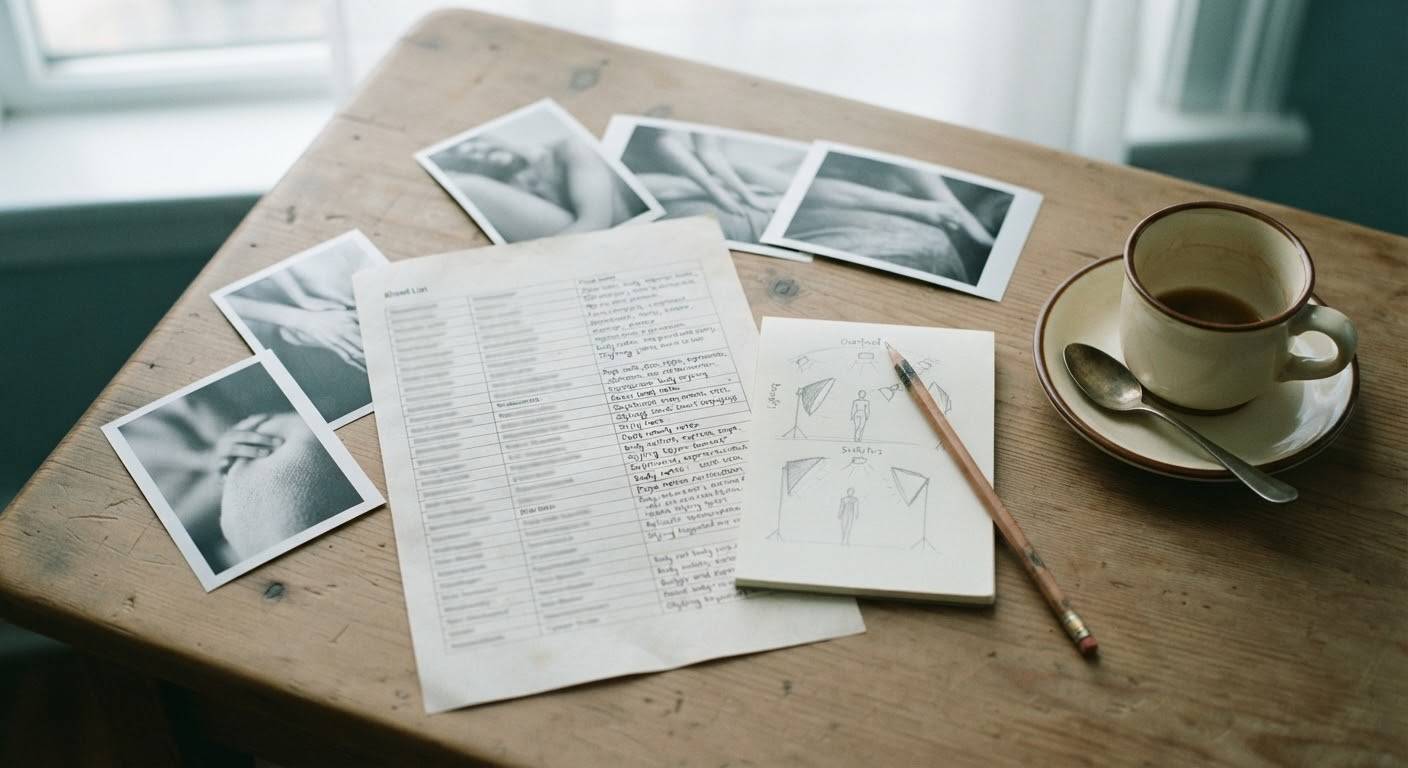
Eight to fifteen planned shots is plenty for a session. You will deviate from the list, as good sessions always do, but you will deviate from somewhere, not from nothing.
Look backward: photography already has a vocabulary
You do not have to invent artistic nudity from scratch. More than a century of photographers have worked on exactly this problem, and their images are the best brief you will ever get.
Spend an evening with the masters before you plan your next set. Look at how Edward Weston and Ruth Bernhard turned the body into sculpture through light alone. How Bill Brandt's wide-angle distortions made the familiar strange. How Man Ray and Lucien Clergue used shadow and pattern. How Jeanloup Sieff and Helmut Newton built entire narratives (power, desire, unease) into a single frame.
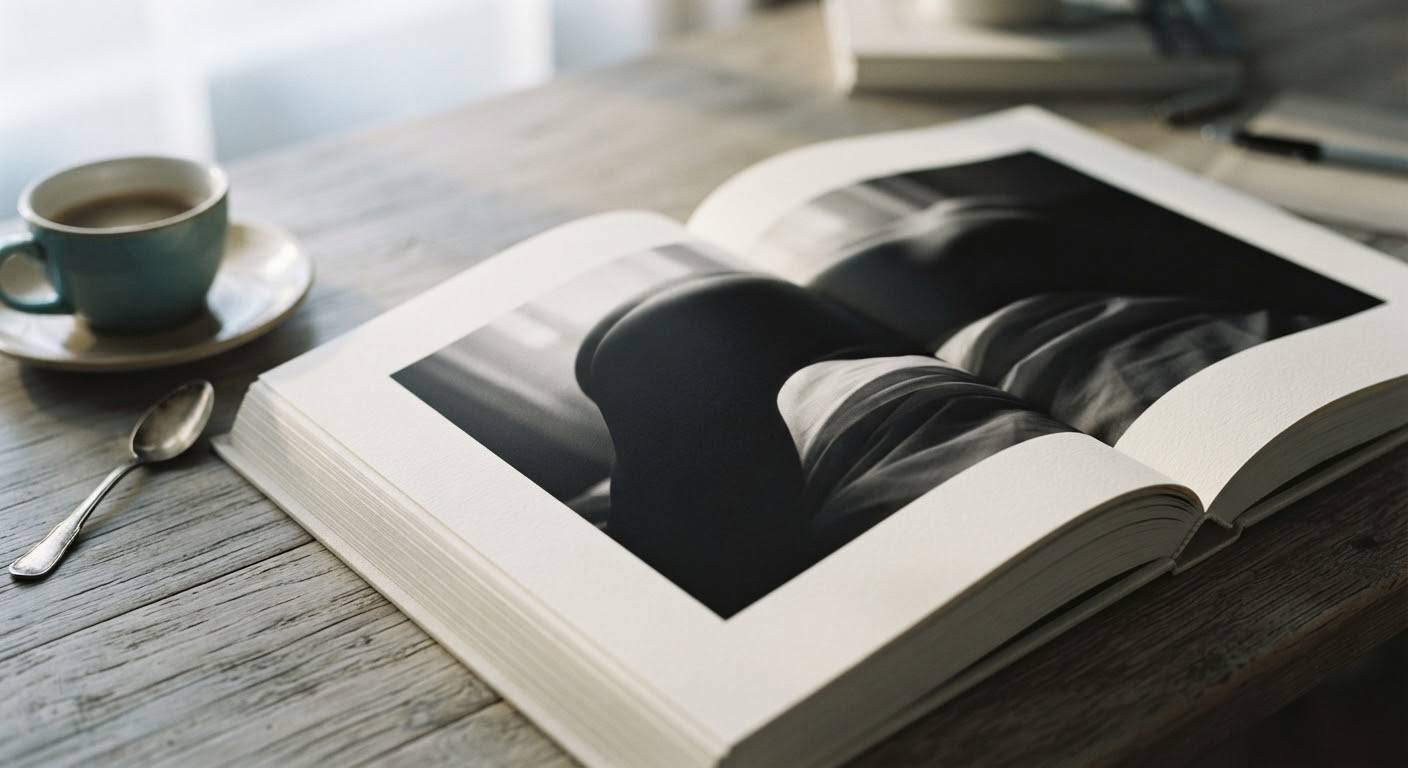
You are not looking for something to copy. You are looking for why those pictures work: where the tension comes from, what the pose withholds, what the light reveals and hides. Then you bring your own idea, your own model and your own decade to it. For lighting, casting and directing on the day, see How to Shoot Artistic Nude Photography.
Use AI as a brainstorming partner
AI tools are genuinely useful at the planning stage: not to make the images, but to help you think. Describe your concept to an AI assistant and ask it to:
- Expand one idea into a sequence. "I want a set about waiting. Suggest ten poses that build tension from boredom to anticipation."
- Draw on photographic history. "Which photographers worked with high-contrast window light on the nude, and what made their compositions distinctive?"
- Structure your shot list. Paste your rough notes and ask it to organise them into a running order, with light and wardrobe changes grouped sensibly.
- Challenge you. "Here is my shot list. Which of these frames feel repetitive or generic, and how could I give them more tension?"
Treat the answers as raw material. Keep what sparks something, discard the rest, and make the final list yours.
Value, or just another set
None of this is compulsory. You can still book a model, switch on the lights and follow a routine, and you will come home with pictures.
But if you want to create a set of images with lasting value, work a buyer remembers, a model is proud to share and you are proud to put your name to, it starts before the shoot. Decide what you are trying to say. Write it down. Share it. Then go and make every frame count.
Otherwise, it is just another box of images, made for looking at and nothing more.